Read below or open PDF version
- Trustpilot is a third-party review site that generates revenue by selling premium memberships to businesses. Our research uncovers mafia-style extortion campaigns against non-paying businesses.
- According to our investigation, Trustpilot creates unsolicited review profiles for all kinds of businesses with the intention to attract hyper-negative reviews and force these businesses into paying subscription deals to “more actively manage” the reviews. Paid-for profiles see their review score magically lift from under 2 of 5 stars to over 4 of 5 stars. Industry experts call this scheme the “Trustpilot Mafia.”
- Reviewers find their genuine negative reviews spuriously challenged or removed for companies that pay Trustpilot. On the other hand, we found countless obviously fake positive reviews and reviewers for paying companies. Trustpilot is either doing a very bad job at policing their website or is willfully negligent when convenient.
- Our statistical analysis underscores how paying as well as non-paying profiles show a concerning pattern of apparently falsified reviews.
- Trustpilot seems to be most appreciated by companies who run sketchy business models. Many companies that are already shut down due to fraud are somehow still extremely highly rated on Trustpilot. We present a long list of examples.
- We uncover a flourishing eco system of third-party entities that sell fake reviews on Trustpilot and openly advertise the success of specific profiles. All the problems are amplified by Trustpilot’s currently extremely prioritized visibility on Google.
- We believe that the public will increasingly wake up to the fact that Trustpilot has traded the integrity of reviews for revenues. We see this resulting in a rapid depreciation of the Trustpilot brand and its fundamental value proposition.
Introduction
Officially, Trustpilot operates on a freemium business model: its platform is free for consumers to read and write reviews and free for businesses to use basic review-management features. Businesses can opt for paid subscription plans that add analytics, marketing tools, “advanced” review-management features, and integration options. These subscriptions are Trustpilot’s main revenue source.
Trustpilot has achieved a high Google ranking, making it challenging for small businesses to thrive if poorly rated on the platform. If you look up “reviews” for an online service or shop on Google, Trustpilot’s scores usually come up as the first search result.
In September 2023, founder and long-term CEO Peter Holten Mühlmann departed, and Adrian Blair took over. Blair is experienced in scaling digital services in hypercompetitive markets. He grew Trustpilot’s revenue by 18.4% in 2023 and 19.5% in 2024. However, our investigation reveals this growth relies on extorting businesses while eroding trust in the brand.
Content
Industry Experts and Insiders Explain How Trustpilot Games Review Scores
We interviewed business owners who paid for Trustpilot subscriptions, those who refused to subscribe, former Trustpilot insiders, and third-party internet reputation experts.
Many business owners described surprise at discovering highly negative ratings on Trustpilot. They reported that Trustpilot refused to remove obviously misleading reviews, for example those for a similarly named product from a different provider, to artificially damage the business’s reputation unless they paid the “Trustpilot Mafia.” Many described bullying tactics reminiscent of a bad 1990s mob movie. This appears to be Trustpilot’s core sales strategy.
Many business owners succumb to Trustpilot and subscribe to premium services, believing they are purchasing 5-star reviews to outweigh the negative ones allowed on the site. An insider stated that Trustpilot receives invitee lists from clients who have vetted the invitees for their willingness to provide positive reviews. Another method Trustpilot uses to influence reviews is selective enforcement, allowing massive spam from fake accounts for paying companies. A third mechanism involves permitting paying businesses to flag negative ratings, which Trustpilot then aggressively removes, often violating its own policies. Trustpilot employs many other tricks to control who leaves reviews on its site. These tactics are known as Review Gating.
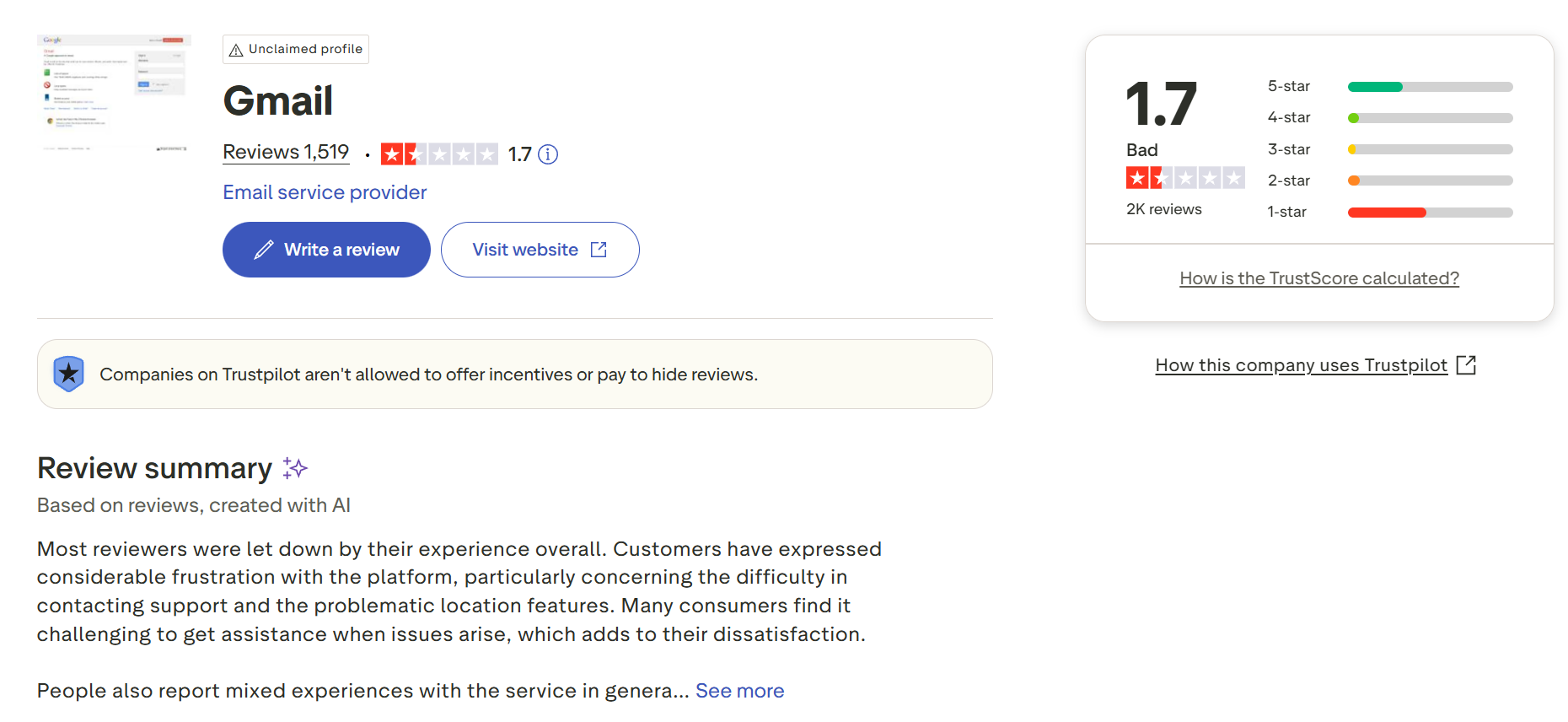
We and many experts we consulted believe Trustpilot is not only engaging in review gating but also actively using illegal tactics to manipulate review scores. This has led to anomalies like Freecash.com, an obscure niche service, amassing over 249,000 reviews on Trustpilot with 4.8 out of 5 stars. For comparison, the largest email service, Gmail, has 1,525 reviews and a 1.6/5 rating; the biggest gaming platform, Steam, has 4,473 reviews and a 1.9/5 rating.
Dependence on Google
Insiders told us that Google’s trust is crucially important for Trustpilot’s business success. However, in January 2025 Google agreed with the U.K. government to stronger penalization of fake reviews, and to “enforce sanctions to deter businesses that try to benefit from fake reviews and sanction those that write fake or misleading reviews.”
Google actively and manually penalizes websites that it deems untrustworthy, unreliable or exploitative (see Reputation Abuse Policy). We show in this report that Trustpilot’s review scores are fundamentally unreliable. When Google realizes that their high-ranking of Trustpilot’s content damages their own reputation, Google might penalize Trustpilot, which would effectively destroy Trustpilot’s entire business model, because Google captures about 90% of the global internet search market.
Trustpilot Scores Really Only Show Who Paid the Extortion Fee
We believe Trustpilot has created a platform to attract bad reviews and customers must pay to dilute the bad reviews. This created a review system that only seems to express who pays Trustpilot.
We examined a range of industries, one of which is U.S. optician brands. If consumers use Google Search to check reviews, they find the Trustpilot scores on the first response page.
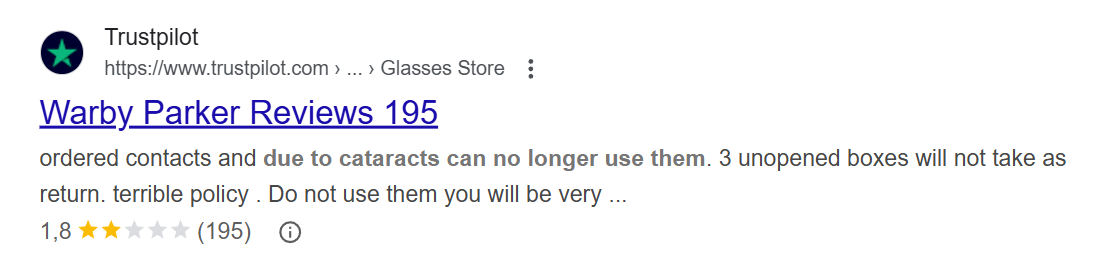
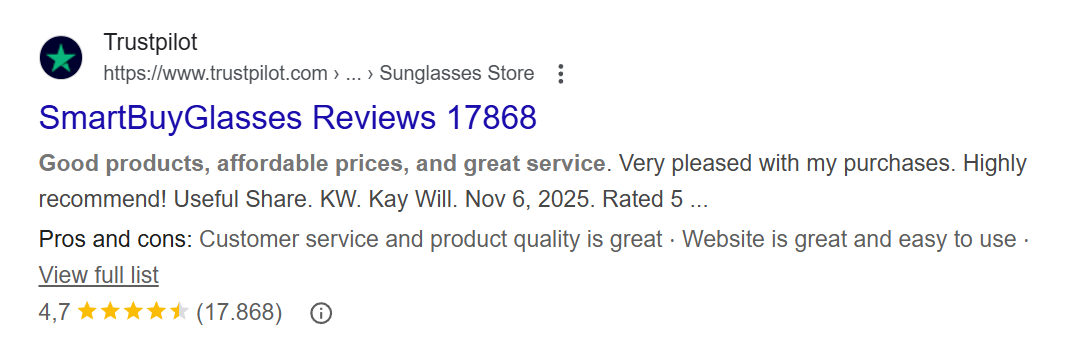
In the following table we see a few of the leading brands and can observe a clear pattern of a division between highly rated brands with thousands of reviews and poorly rated brands with less reviews. All poorly rated brands are “unclaimed profiles”, meaning that these brands have not subscribed to Trustpilot. The highly rated brands show up as “claimed profile”, and are, therefore, on a Trustpilot plan. The high amount and frequency of reviews for these brands indicate the use of paid subscription features.
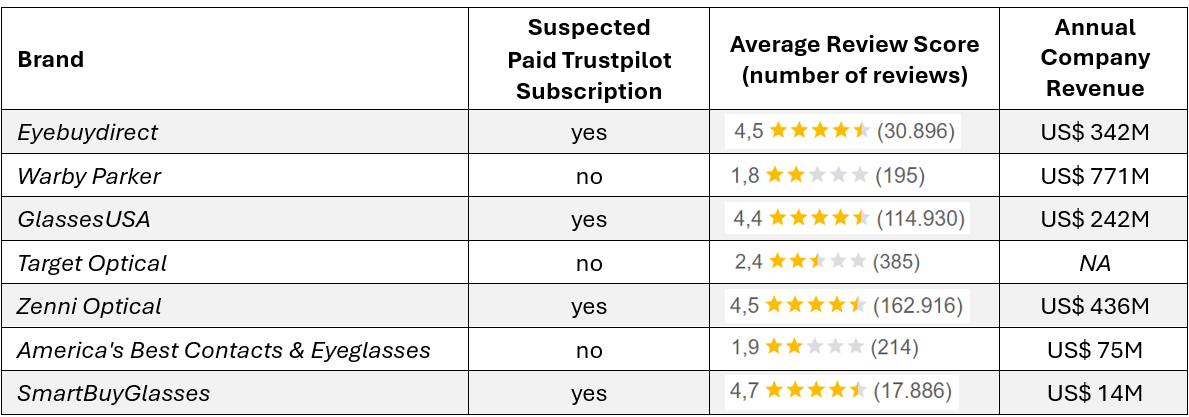
Data retrieved on November 26, 2025
The brands in the table all have sufficient market penetration and, according to our research, fairly similar customer satisfaction. We checked multiple other review sites and the stark contrast in Trustpilot review scores seems unjustifiable. The non-subscribed businesses can decide to either pay Trustpilot to fix the problem or to swallow terrible review scores.
Most importantly, the review results in the table summarized above seem to provide helpful insights for potential customers, but they are not. They are just indicators for who pays Trustpilot and who refuses to pay.
This pattern is not an exception but a systematic occurrence. Here are a few other examples.
The U.K. has five large retail internet providers with market share above 5%. However, only Vodafone UK seems to pay Trustpilot enough to inflate its score. Broadband internet is a highly commoditized industry with extremely comparable product quality. This comparable quality is reflected in closely similar average review scores across the brands by other review sites, like broadband.co.uk or reviews.io. If Trustpilot’s scores were genuine, every client would change to Vodafone UK, but the company has only weak market share in the UK.
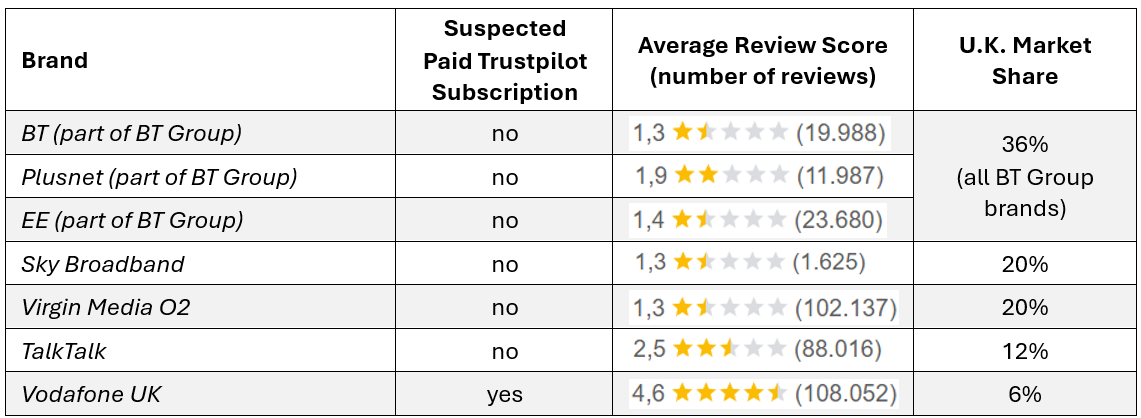
Data retrieved on November 27, 2025. Market shares by fibrecompare.com
Interestingly, one and the same company, Vodafone, seems to only pay Trustpilot for the U.K. market, where Trustpilot is more commonly used by consumers than in the other markets. In other regional markets, the Trustpilot score is dramatically lower. This makes obviously no sense, because why would Vodafone’s service in the U.K. be stellar but terrible in the other markets, where Vodafone even has much higher market shares.
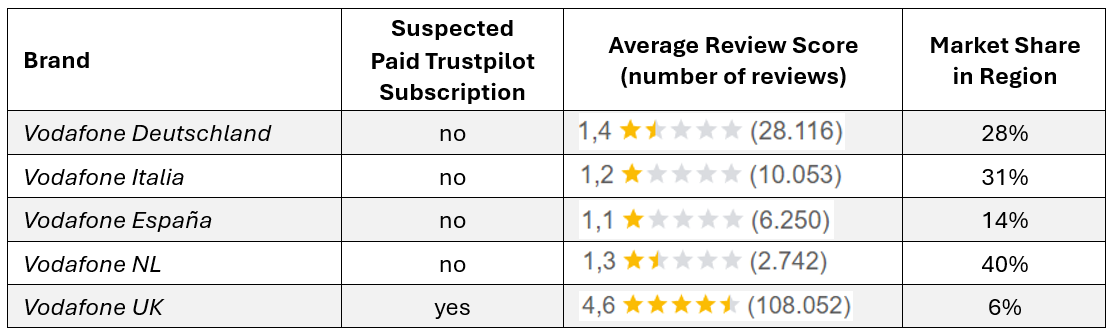
Data retrieved on November 27, 2025. Regional market shares from different sources.
Yet another example are the biggest washing machine brands in the U.K. market. Users don’t see who has the most reliable machines, but who pays Trustpilot to manipulate the scores.
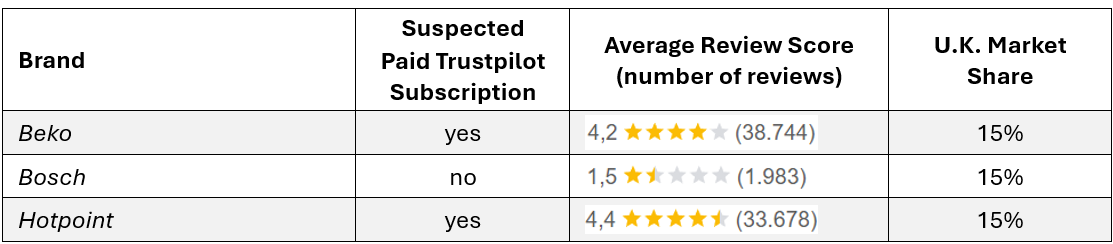
Data retrieved on November 27, 2025. Market share data from ransomspares.co.uk
Other examples include big online pharmacy brands, where paying providers, like Boots and DocMorris reach a 4.5 and 4.6 rating, while the U.S. giants Walgreens and CVS Pharmacy have average ratings of only 1.5 and 1.6. The largest U.S. gym chains are another example; while Planet Fitness as a 4.2 rating from 62k reviews, Anytime Fitness as a 2.4 rating, Orangetheory a 2.2, LA Fitness a 1.6, and Crunch Fitness a 1.9 rating, each from less than 1,000 reviews.
Trustpilot’s Selective Enforcement
Trustpilot claims to remove fake reviews by employing sophisticated AI tools and manual processes. However, a quick glance through the 5-star reviews reveals that this cannot be the case, because countless obviously fake reviews are not removed.
Trustpilot is either terrible at enforcing its own policies, or, as we believe, is selective in enforcement based on who is a paying client.
A former insider with intimate knowledge of the internal processes claimed that during her/his time at the company the founder touted that the content integrity team is “50 people strong”, while, due to Chinese Wall reasons, staff employees never saw a detailed list of these individuals. However, the insider believed that the team had “6 people at most.”
Repeated Review Spam
Many reviewer accounts very obviously aim to prop up certain businesses by leaving reviews in a spam pattern that Trustpilot tolerates.
For example, user Jeff Blitstein posted fifteen 5-star reviews for the trading app Trade Algo. We found further accounts that spammed good reviews for Trade Algo: David Long posted fourteen, Ryan Schutte posted eleven; Steven Mazer posted nine; MPH posted seven; Dexter, John W, Adam Becker, Tony Neumeyer, Kirk Keder each posted six; Stephen Puco, Sara Mangum, TREK BIKE SHOP OF NAPLES each posted five; GIL G, Rhonda, jack t Krauser, Michael Zarnott, Nicholas VerSteeg, Yvette W., Steve Ventura each, Jim, John Bailey, Elmer Fudd each posted four. These are the spam accounts with at least four positive reviews for Trade Algo among the latest two-hundred posts. In other words, the majority of good reviews for Trade Algo comes from such spam accounts and Trustpilot tolerates it.
Here are a few other examples: ACE Money Transfer receives twenty-four 5-star reviews from user Alhagie Kinteh, twenty-four 5-star reviews and one 4-star review from user Muhamadou Ceesay, eleven 5-star reviews from Qais Mehmood, and many more very good reviews from users like this. TriftBooks receives twenty-seven 5-star reviews from user Henry. Xoom receives eight 5-star reviews from user Carlos Oliveira. Instant Gaming receives seven-teen 5-star reviews from user Alligatoras.
Even if some of these reviewers were genuine reviews, Trustpilot clearly allows a distortion of its scores from review spam that can very easily be prevented.
Gibberish Review Texts
Some 5-star reviews on several Trustpilot subscription customers’ pages are just unrelated text or meaningless strings. These reviews do not appear under featured reviews, but they provide 5-star reviews for the statistic. Clearly, Trustpilot doesn’t check if the texts are actual reviews, which can be easily automated with modern AI LLMs. Here are a few examples:
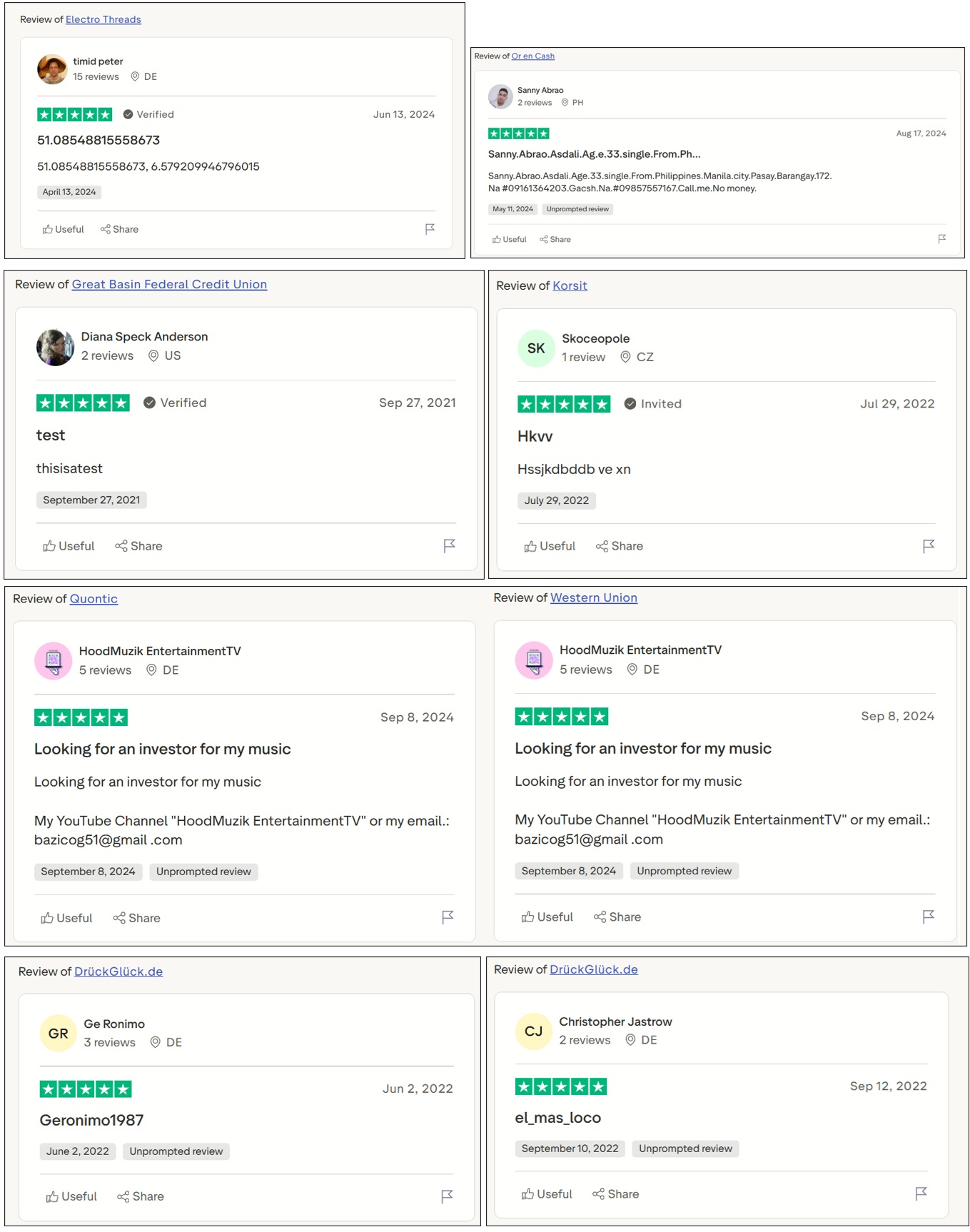
Location Misfit Between Reviewer and Service
Other examples of obvious fake reviews are from accounts with seemingly natural sounding names, sometimes with generic AI-looking headshot photos as avatar images. These people cannot be found on any other database or social media. We found countless accounts of this kind on Trustpilot. Here are a few examples.
The alleged Austrian user Mark Bausman left reviews for Austrian businesses but also for a grave headstone maker in Ohio, U.S.A., a Swedish fabrics retailer, an orthopedics retailer from California, U.S.A., and a now defunct Russian broker company in Russian.
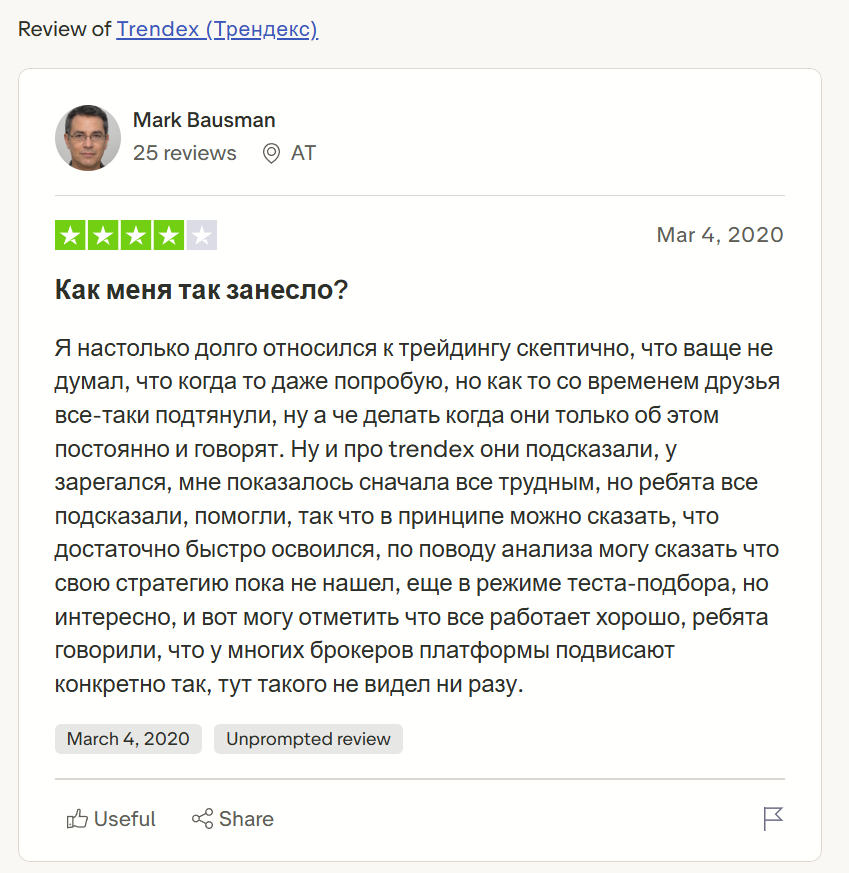
The oddity of the global and unusual purchases is not addressed in any of the review texts.
The allegedly Vietnamese user Liem Tao posted reviews for Vietnamese companies, but also the German electrics retailer ALTERNATE.de, a North American gym chain, and a Dutch retailer for refurbished Apple devices.
The allegedly German user Winfried Conrad gave 5-star reviews to a U.S. pet store, a U.S cake store, a meal delivery company in London, a U.S. beauty store, a Swedish clothing seller, U.S. doll store, and a few German companies, and, of course, a now defunct brokerage firm registered in Cyprus.
Clearly localized businesses can have plenty of reviews from abroad. For example, the Great Basin Federal Credit Union requires for their customers to “live, work, worship, go to school or own a business” in one of their designated counties in Northern Nevada or Treasure Valley, Idaho, U.S.A. On Trustpilot they have reviews from users from Egypt, Pakistan, Ukraine, Germany, Canada, Ethiopia, Saudi Arabia, India, Nigeria, Kenya, and Austria.
Image Reverse Search
Fake profile images can be detected very easily via image reverse search. When a profile uses stock images for profile pictures this is usually a sign that the profile is not authentic. Here is an example that we run through TinyEye reverse search. This check can easily be automated for all review profiles but apparently Trustpilot fails to do that.
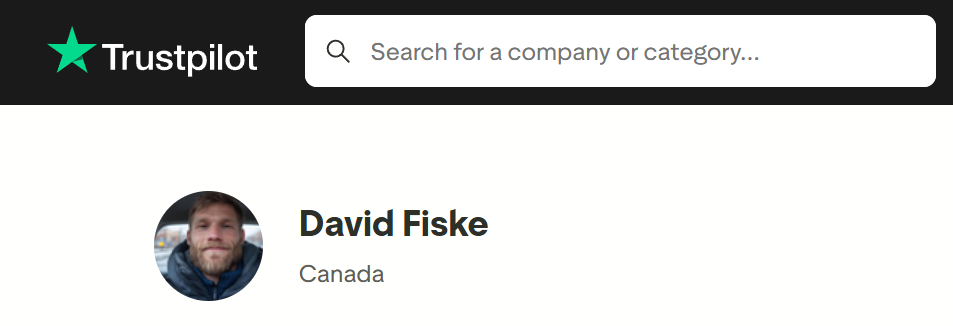
https://ca.trustpilot.com/users/6533be3136cadf0012d1b1ea
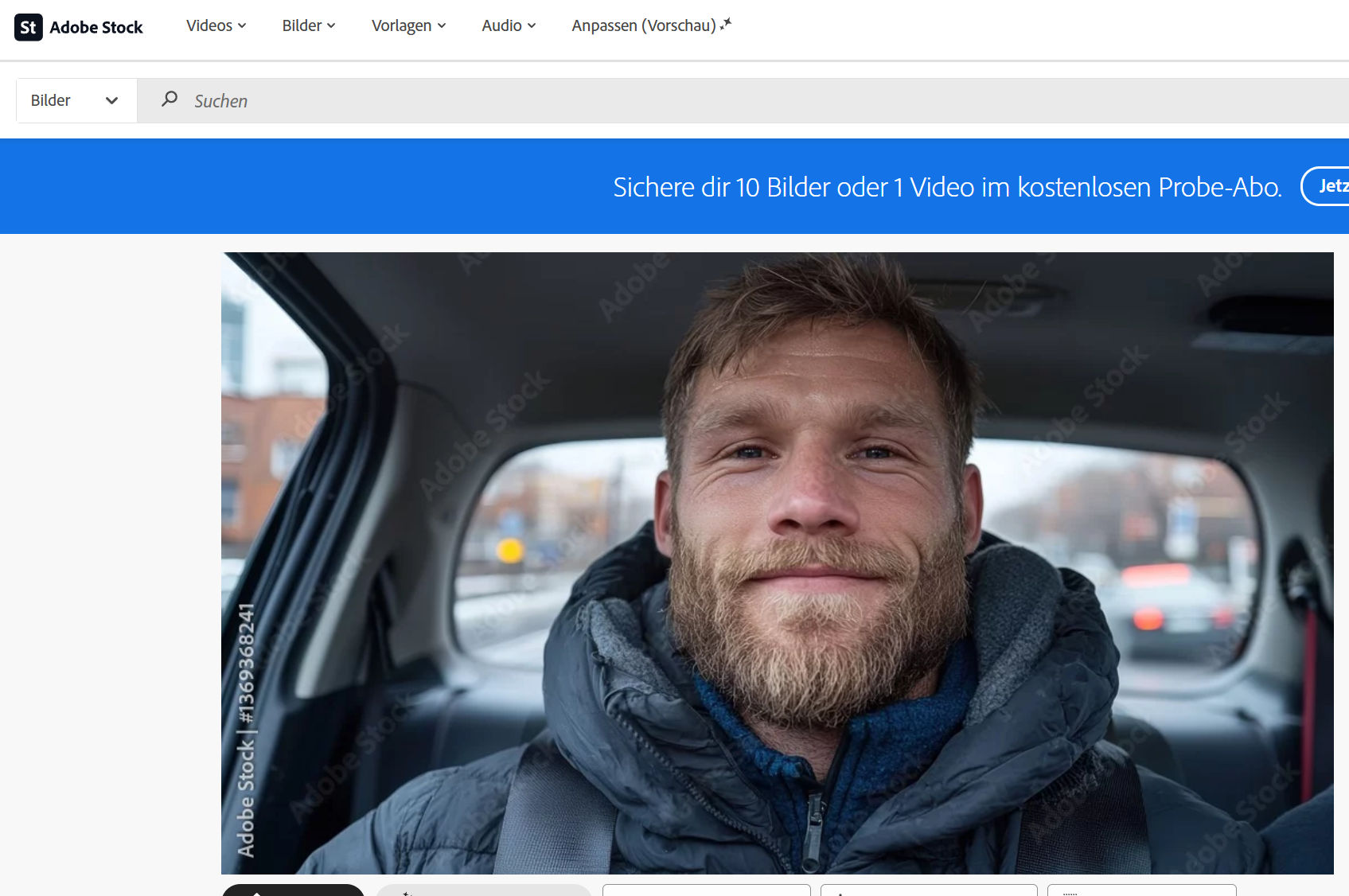
https://stock.adobe.com/de/images/A-man-smiles-in-the-front-seat-of-a-car./1369368241
Here are more of such cases of stock photos used as Trustpilot avatars that we found after a few minutes of online search.
The Illegal Trustpilot Fake Review Market
Third-parties like BlackHatWorld.com facilitate a massive black market for illegal fake reviews on Trustpilot. On BlackHatWorld we found 200 ads that offer fake reviews on Trustpilot. The site only shows the latest 200 entries and the 200th entry was only nine weeks old, indicating that the market is very active. These entities use anonymous usernames customers can reach out to. They promise “non-drop” and “sticky” characteristics, meaning that their fake reviews will survive the alleged review authenticity check.
Experts told us that blacklisting certain IPs, including those from VPN providers, public networks, and internet cafés, can easily prevent mass fake review production. This leads us to conclude that Trustpilot is not only accepting but fostering fake review services as it gives Trustpilot the opportunity for selective enforcement that benefits paying clients and hurts non-paying businesses.
Here are a few examples of the ads:

User SuperSeoteam: “Buy sticky Trustpilot reviews that don’t drop. Our Trustpilot review agency delivers 100% live, natural reviews with 1-year guarantee.”
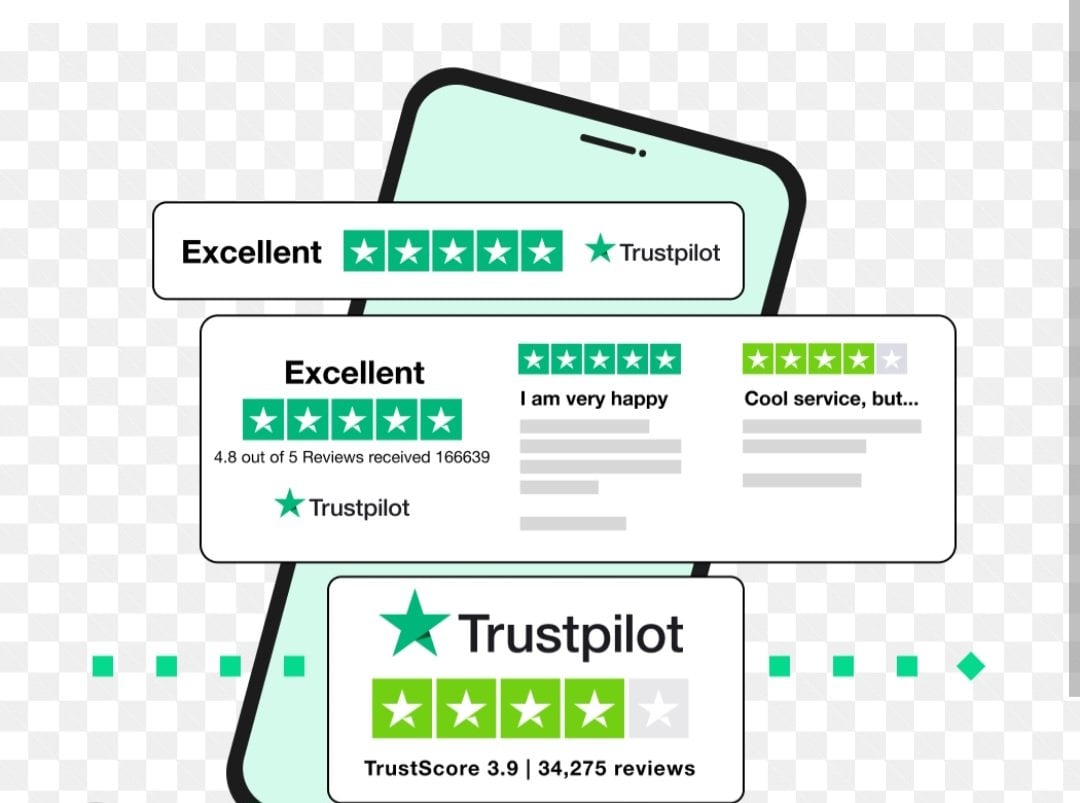
User Seo_solve advertises “Offering top-tier Trustpilot reviews starting at just $4 for non-sticky and $15 for guaranteed sticky reviews with aged accounts. Bulk discounts available!”
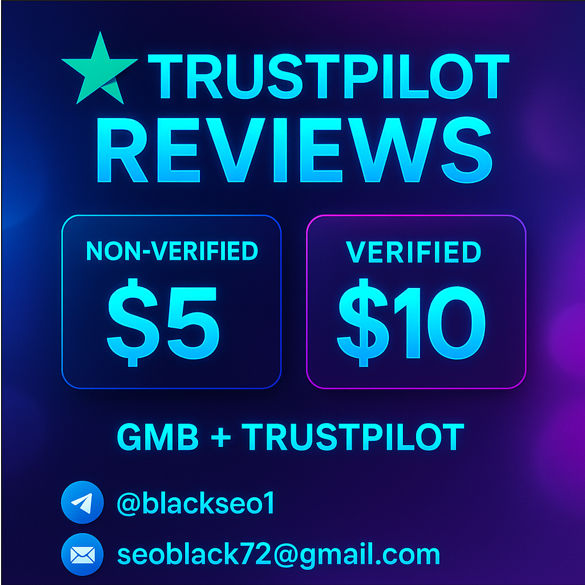
User Black_seo offers “Boost your online reputation with our premium Trustpilot review services. We provide both Verified Trustpilot Reviews ($10) and Non-Verified Trustpilot Reviews ($5). Perfect for businesses looking to increase credibility, attract more customers, and rank higher in search engines.”

User Henry91
We reached out to the review sellers, masquerading us as interested customers and asked for their service to buy “about 100 5-star reviews per month” for our business. We asked the sellers to show us their references of business profiles on Trustpilot that they have propped up with their fake reviews.
Here are the companies that buy fake reviews:
BankFive (4.7 stars, 5,146 reviews) is a community bank in SouthCoast Massachusetts and Rhode Island. SuperSEOTeam mentions them as a client in their ads.
Fuppies (3.7, 120), a U.K.-based doll maker. [email protected] told us, they are providing fake reviews for them.
Great Basin Federal Credit Union (4.5, 601) is a federally chartered credit union based in Reno, Nevada, USA. [email protected] told us, they are providing fake reviews for them.
Orbismed Clinics (4.8, 264), a dental clinic in Turkey for Western clients. [email protected] told us, they are providing fake reviews for them.
24yield (4.0, 100), a French financial securities trading platform. [email protected] told us, they are providing fake reviews for them.
Further businesses that [email protected] told us are his clients: Anosim (4.8, 37), Akki (4.2, 8), Deleteapp (4.4, 11), Proxied – Mobile Proxy Marketplace (3.9, 17), SFX Funded (4.2, 174). [email protected]’s fake accounts also posted 5-star reviews for the following businesses, who were, therefore, likely his clients, too: Indie Campers (4.0, 21,571), xAutomation (4.5, 34), DCT Digital Coins & Trades GmbH (4.4, 11), Swedex GmbH (3.9, 657), Nexo Ki (3.9, 8), and Fvsource (4.0, 3).
Here are some fake reviews that the providers presented to us as their work:
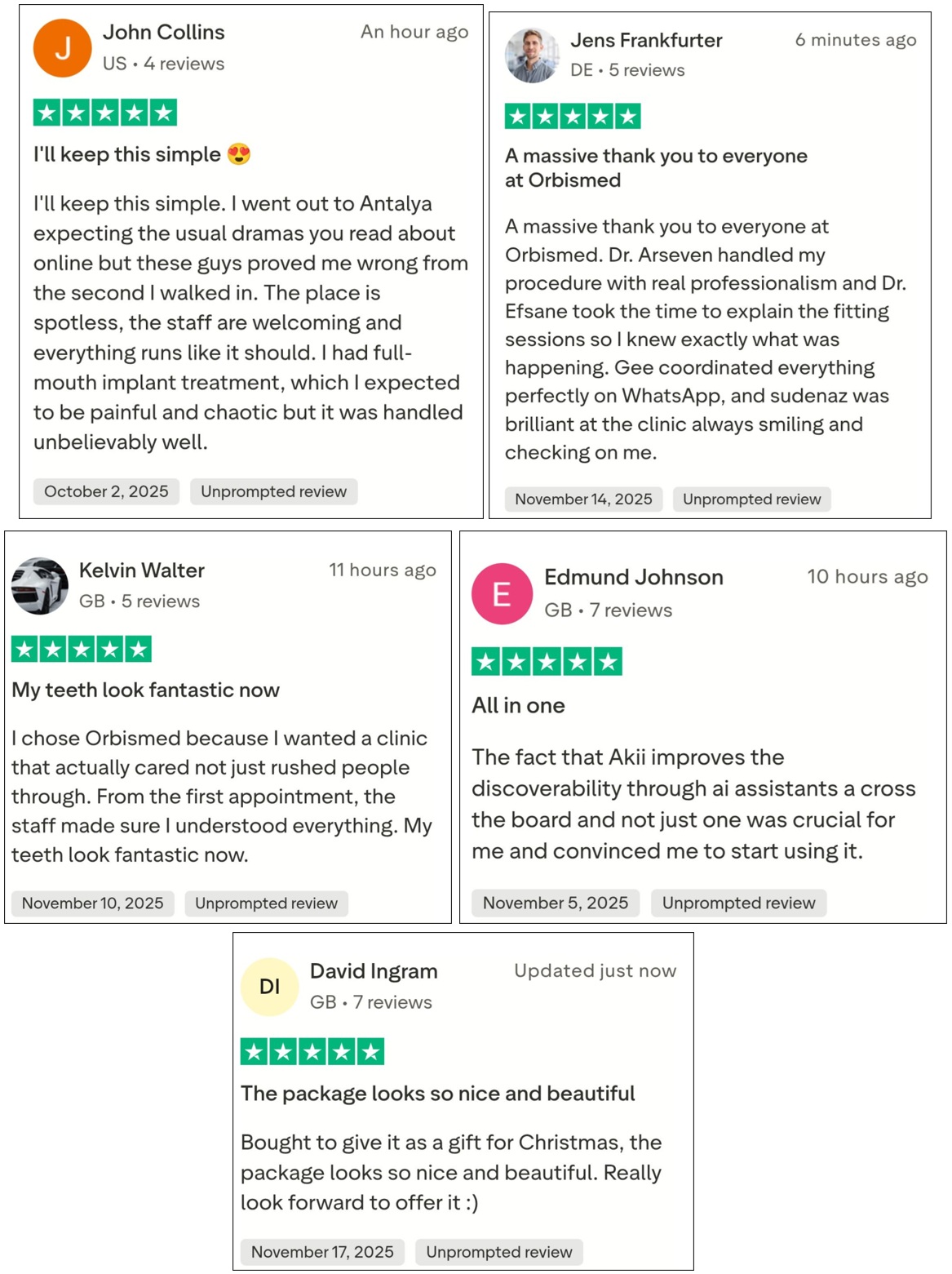
We also asked the sellers directly how they prevent the fake reviews from being taken down. We got the following replies:
- “Aged and trusted profiles”
- “Country-matched traffic”
- “Natural posting patterns (not all at once)”
- “Clean fingerprints, cookies & unique devices”
- “Slow start for the first few days, then consistent posting”
Leading World-Class Services Have Mostly Terrible Average Reviews
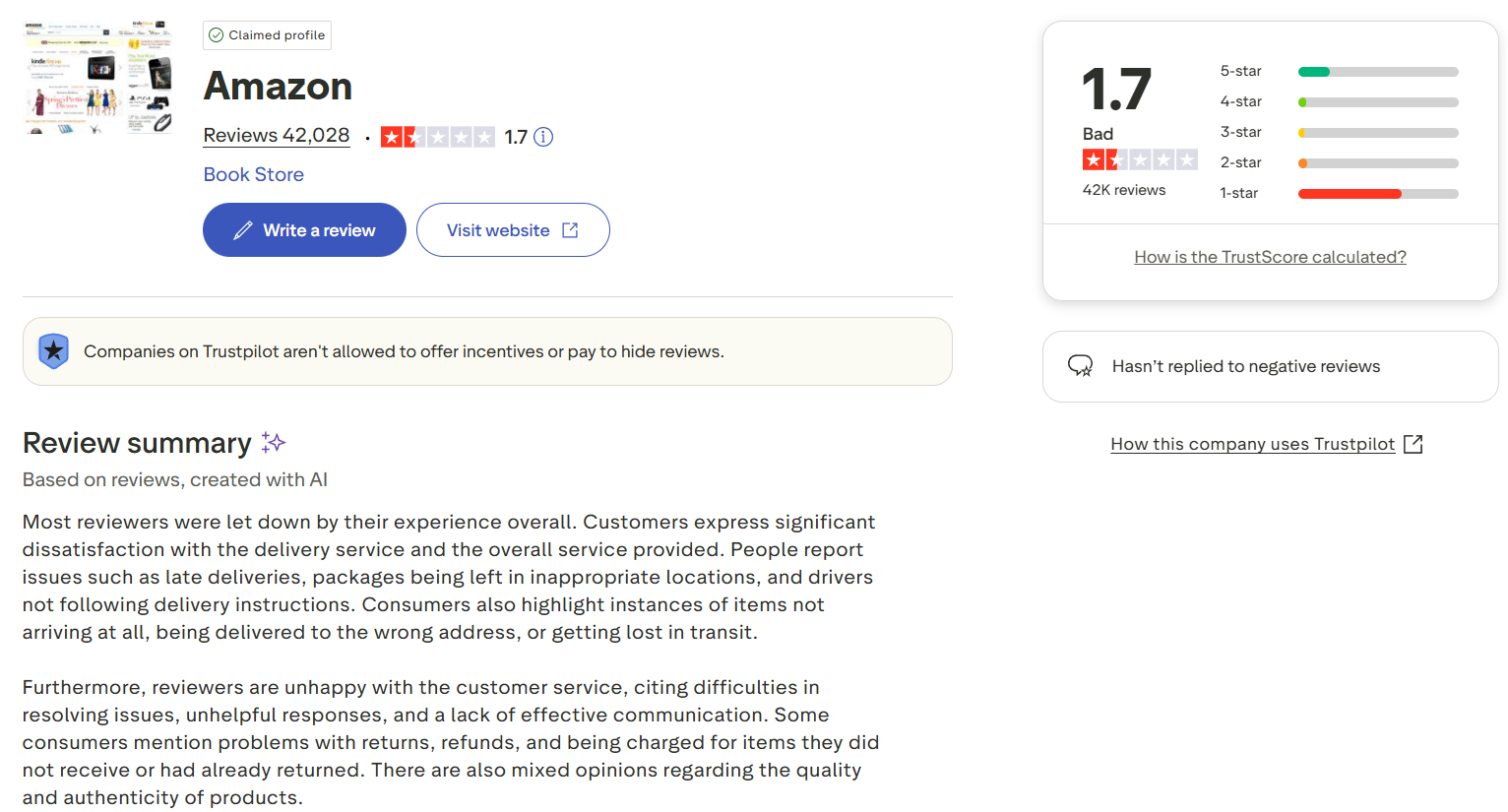
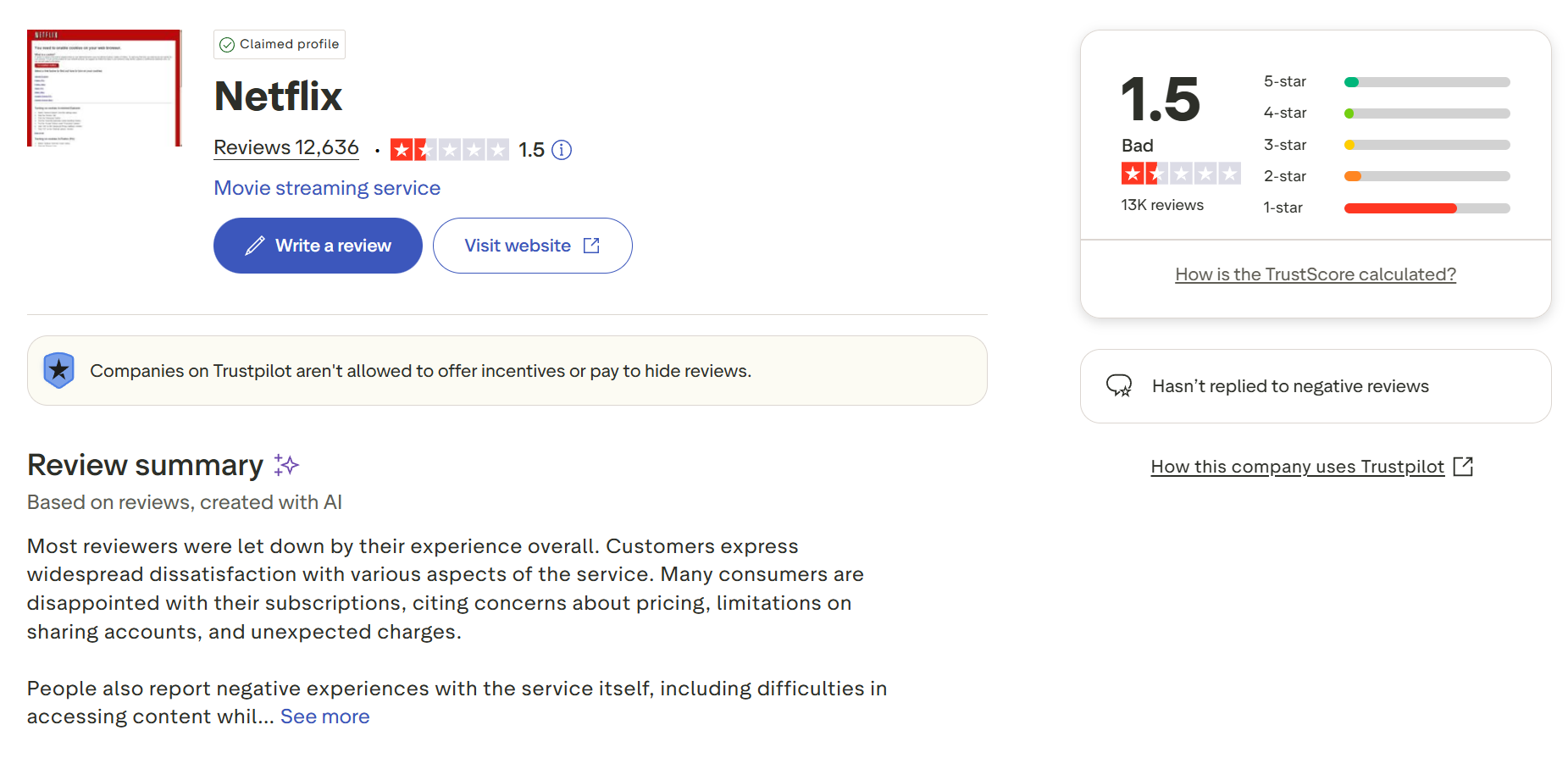
Services from leading international brands, like Apple, Google, Microsoft, Samsung, and many others consistently have ratings below three or even two stars, while niche services like Freecash.com have hundreds of thousands of glaring reviews. These results point to obviously illegitimate reviews in large quantities. Leading global service providers don’t care much about their Trustpilot rating, they refuse to pay subscription fees to Trustpilot. That’s why they are flagged as “Unclaimed profile” and thus Trustpilot tilts their reviews towards a very bad result.
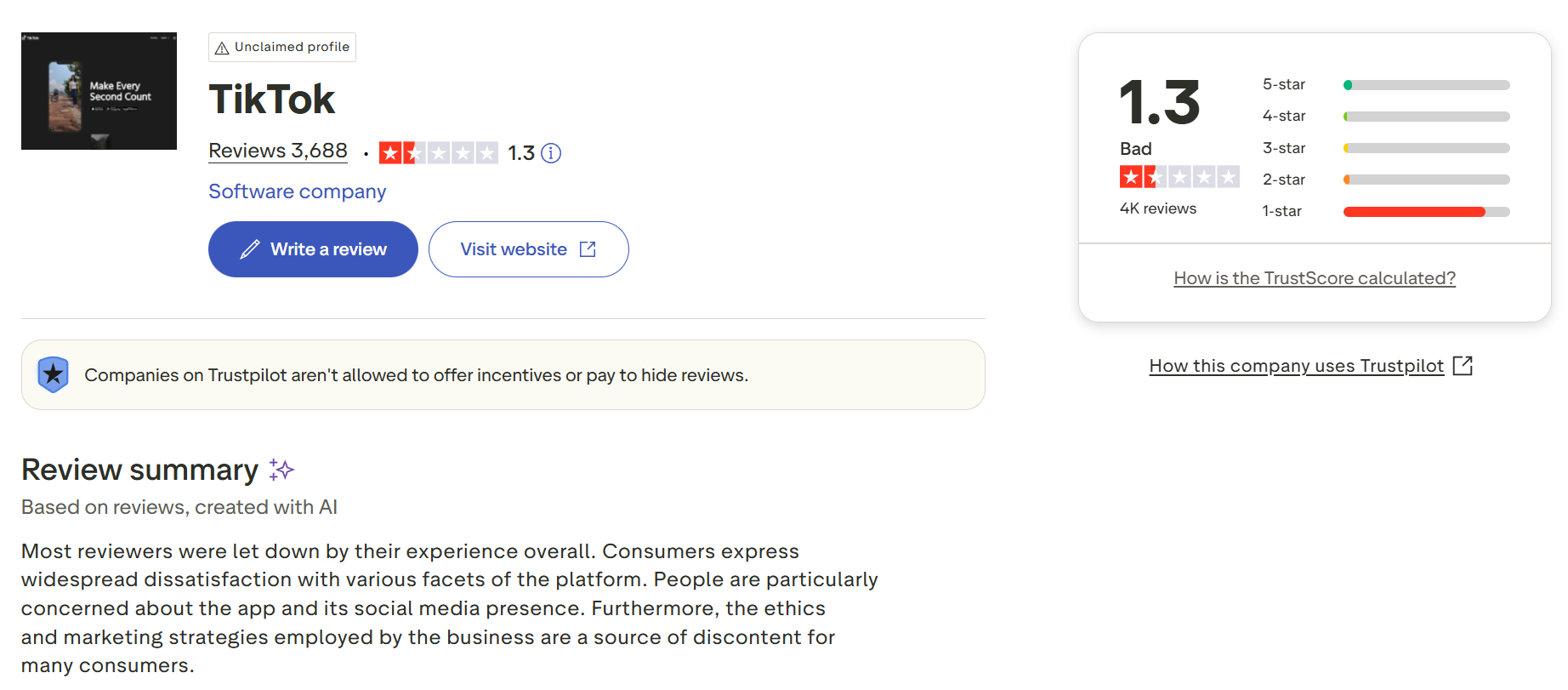
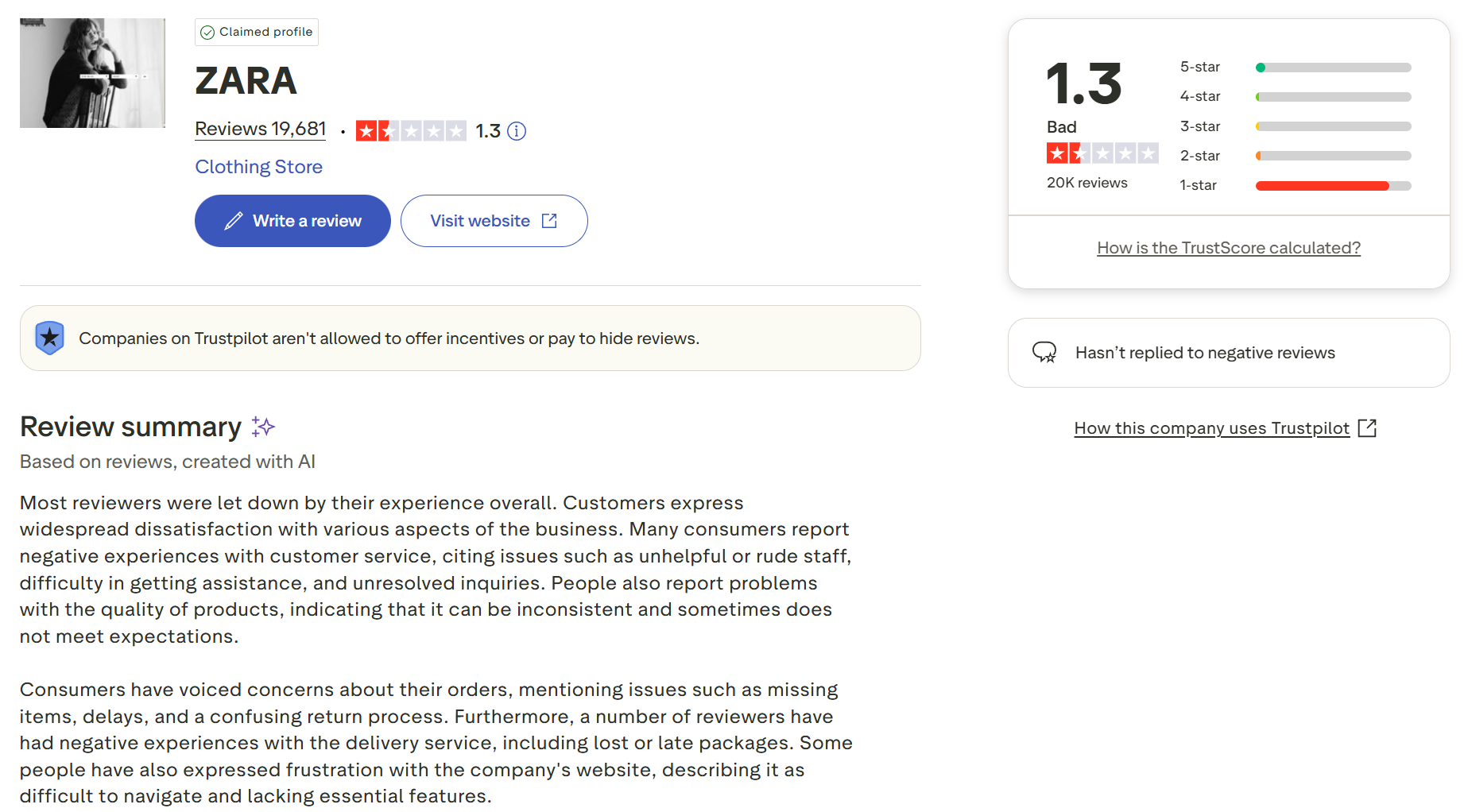
Loved by Scam Businesses Around the World
As opposed to strong global brands who do not care about Trustpilot, fraudulent businesses seem to love Trustpilot to generate undeserved trust. We found countless examples, many of which we list here.
Example: EminiFX – CEO in Jail for Fraud, Yet Still Highly Rated
EminiFX, a financial services company, became widely known after its CEO was sentenced to 9 years in prison for orchestrating the $248 million fraud scheme back in 2023 and the website now redirects to a receivership portal. Despite this, its Trustpilot account remains active with a 4.4-star rating.
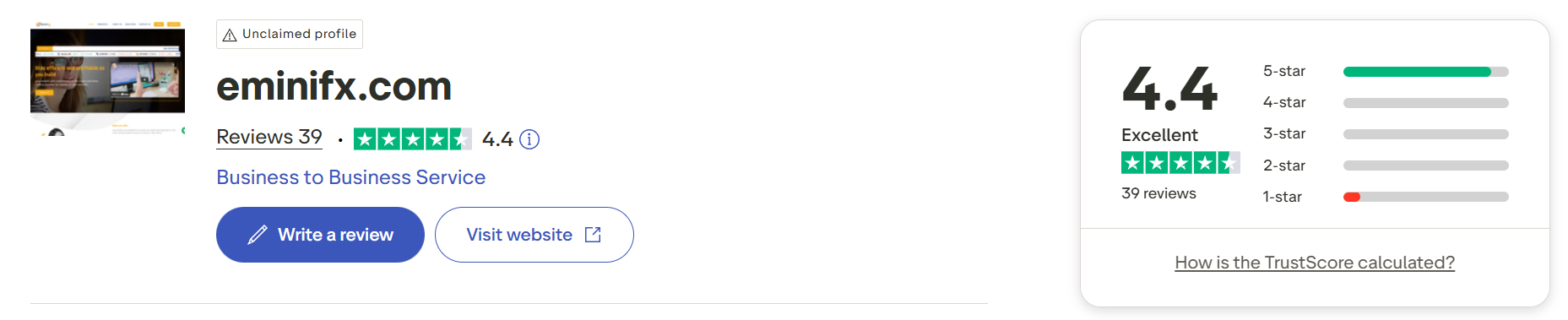
EminiFX’s Trustpilot page
EminiFX has always been an unregulated offshore broker, which indicates a high probability of being questionable. The one Glassdoor review that EminiFX has is from 2022 and calls EiminiFX “a pyramid scheme.”
Apparently fake 5-star reviews are still online.
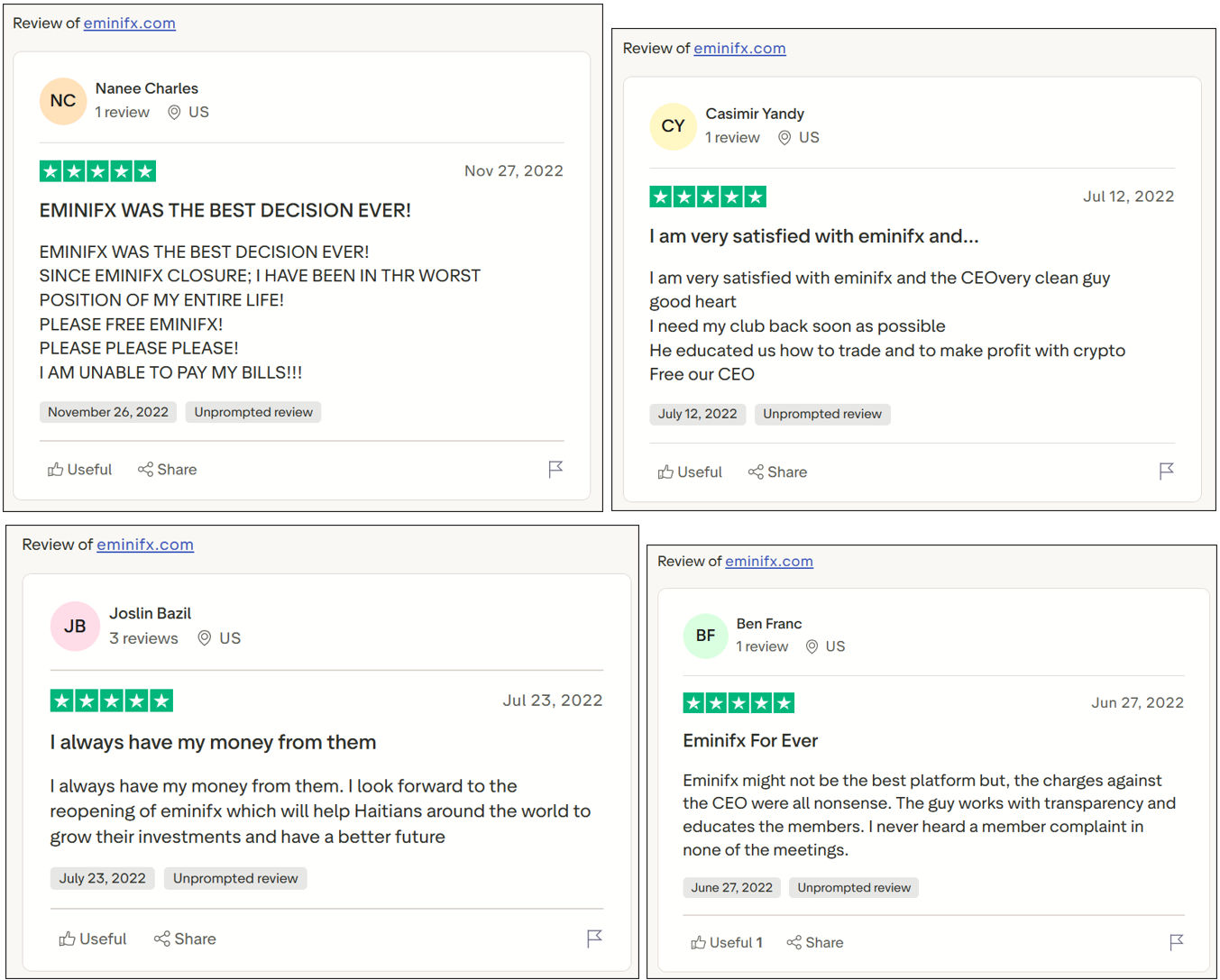
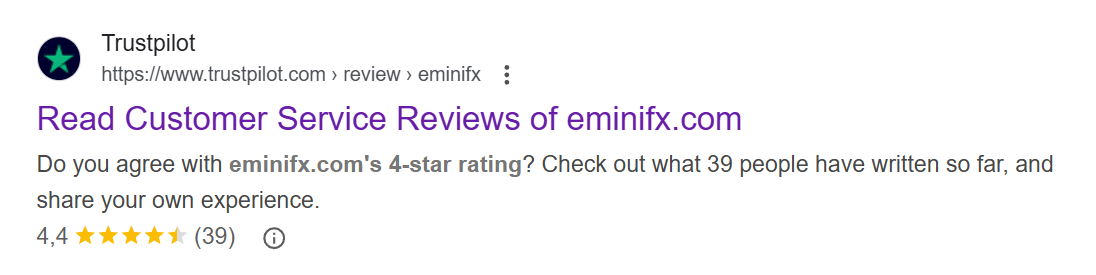
First result on Google for “EminiFX, reviews”
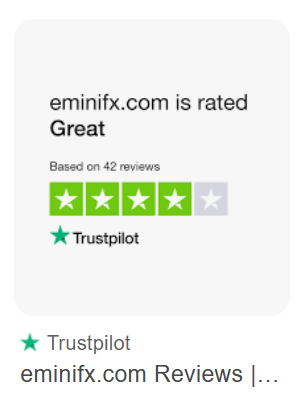
Third Google image search result for “EminiFX, reviews”
Example: 24yield – Fake Foreign Exchange Broker Already Flagged by the FCA
We identified a profile on Trustpilot for a company named 24yield, which describes itself as “a regulated forex broker committed to providing a secure, transparent, and client-focused trading experience.” The firm currently holds a 4.0-star rating based on over 100 reviews. An examination of negative feedback on Trustpilot indicates concerns regarding potentially fraudulent activity.
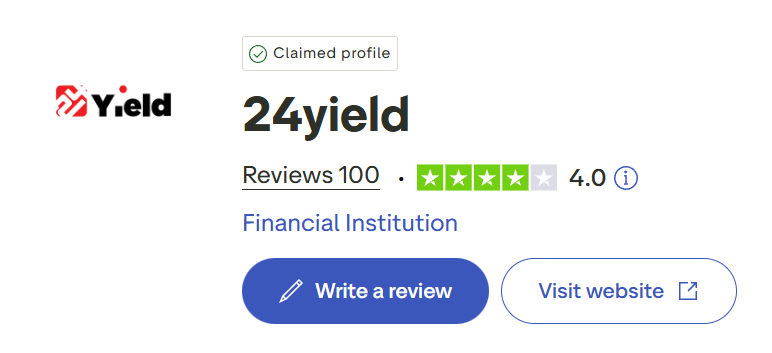
https://www.trustpilot.com/review/24yield.com
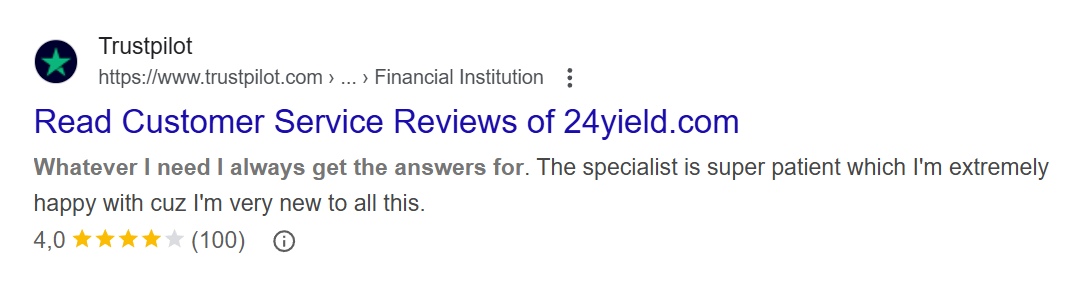
Google’s first link when searching “24yield, reviews”
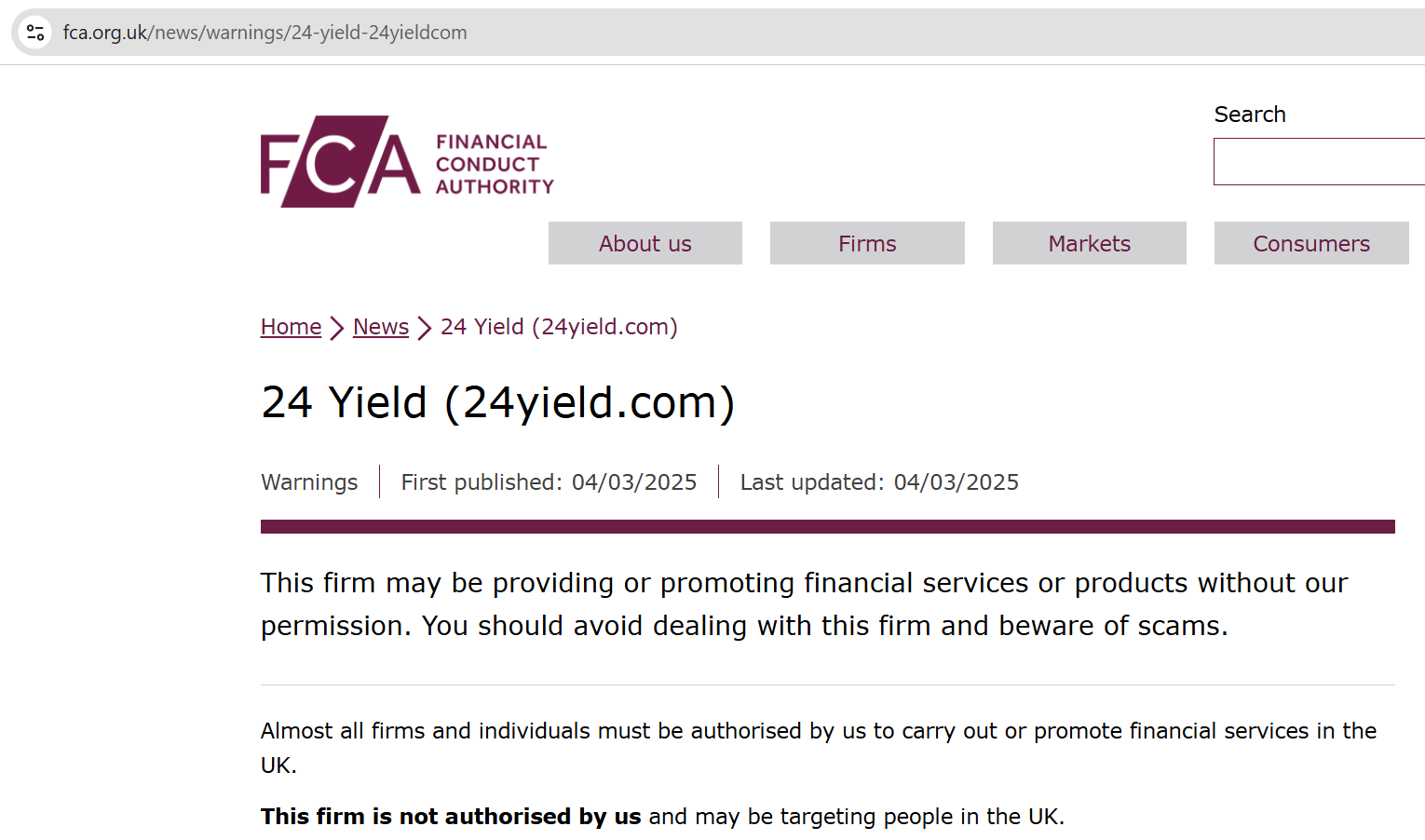
Upon reviewing the company’s website, it appears to be operated by undisclosed individuals, with several AI-generated images and stock images populating the site as the team. Further investigation revealed that the Financial Conduct Authority (FCA) in the United Kingdom has issued a warning stating that 24yield is not authorized “to carry out or promote financial services in the UK.” The FCA advises investors to refrain from engaging with 24 Yield and to exercise caution due to the absence of required authorization for most financial activities within the UK.
Example: egg.fi – A Dead Token Scam Stays Alive on Trustpilot
Egg.fi describes its offer in its Trustpilot profile as a “Multi-Chain #DeFi Dashboard. Low Cross-Chain Swap Fees & Ranked Yield Farming. Track & Compare Performance.”
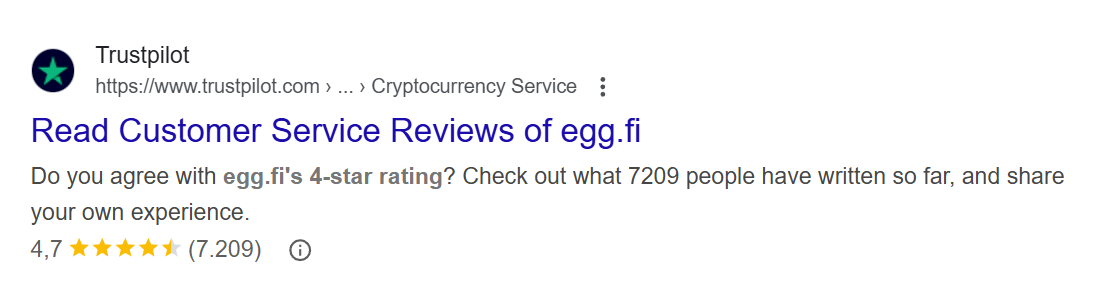
First Google search result for “egg.fi, reviews”
The domain egg.fi now routes users to some kind of meaningless login mask.
As of recent data, the token natural for the function of egg.fi (often shown as “EGG” or “EGG Protocol”) shows zero circulating supply and zero total supply — meaning there appears to be no active or valid token supply. Users have no way to retrieve the holdings they put into the platform and remain defrauded.
Example: NovaWallet – A Wallet Scam Powered by Trustpilot
NovaWallet was a crypto wallet app. Its website novawallet.co.uk was shut down and now redirects to an unrelated AI bot project. Users who had still assets in their wallets cannot withdraw them anymore and remain defrauded.
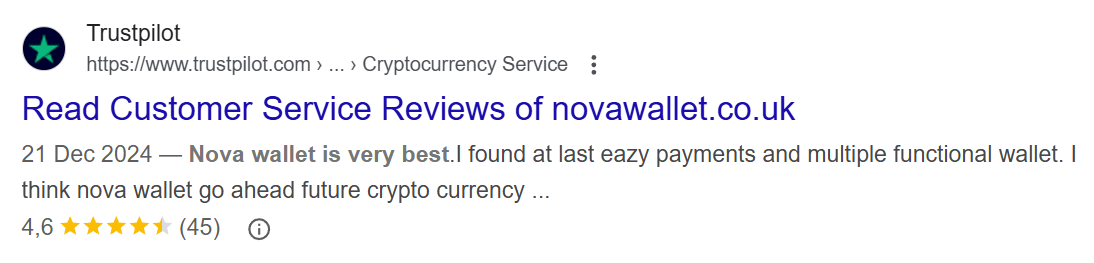
Second Google search result for “novawallets, reviews”
Example: Crypto Family – A Typical Shitcoin Ponzi
The now defunct website cryptofamilylove.co (accessible via Web Archive) describes Crypto Family as a “complete ecosystem to help families thrive and transform their economies through the power of decentralized finance.” Crypto Family is rated 4.0 on Trustpilot.
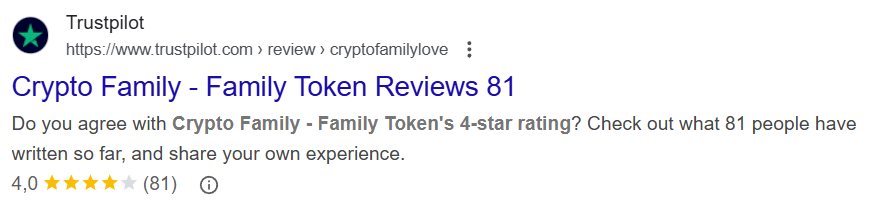
First Google search result for “Crypto Family, reviews”
Crypto Family was founded by Đorđe Petrović in Dubai, a known hub for Ponzi schemes. Petrović is a serial Ponzi schemer, according to an investigation by BehindMLM.com. Petrović was already involved in earlier Ponzis, where he learned the craft, and launched Crypto Family as a fake crypto coin/NFT Ponzi in 2022.
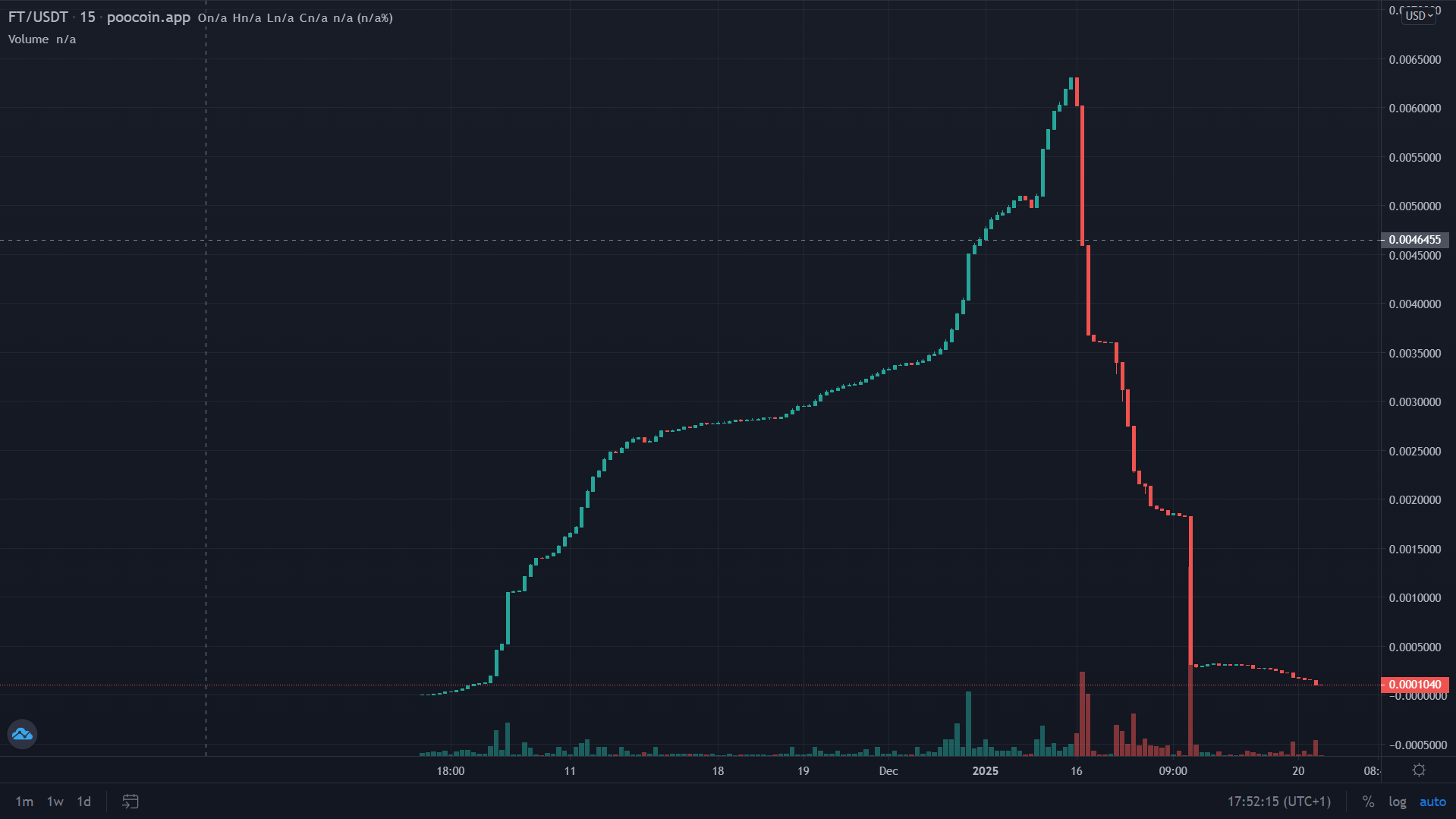
Crypto Family issued the Family Token (FT), which inevitable collapsed in October 2025
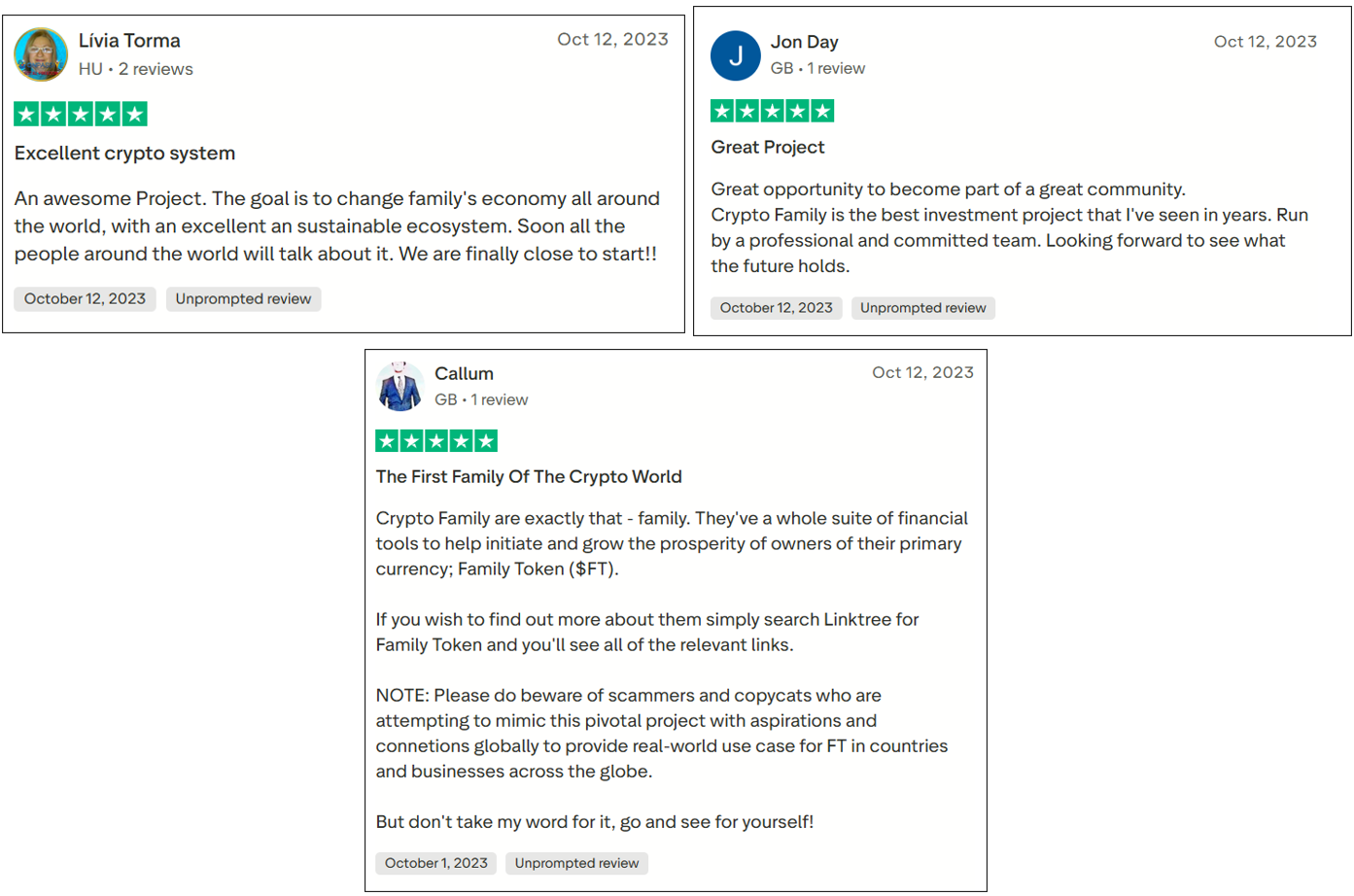
Trustpilot’s review page for Crypto Family is spammed with 5-star reviews praising the project. Here are a few examples:
Example: Exabit – A Crypto Mining Scammer
Exabit describes its service as “Allowing anyone to remotely own a cutting edge mining rig and mine crypto 7/24, Exabit stands out with its high profitability, security and transparency mining features.”
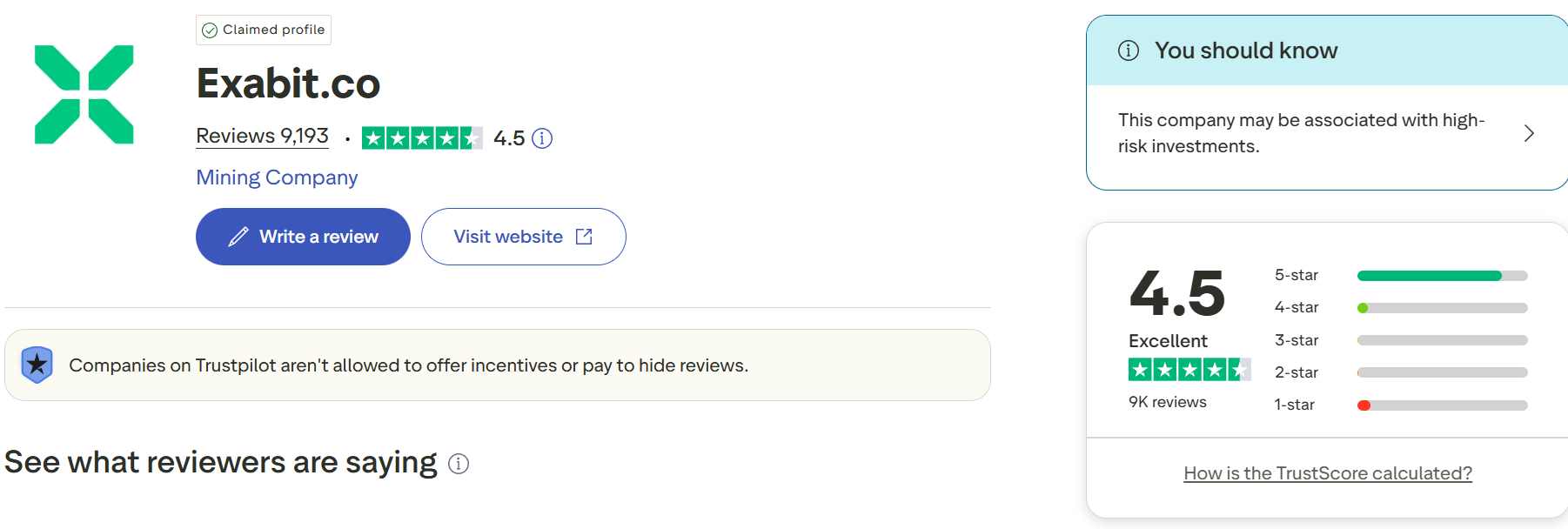
Exabit’s profile page on Trustpilot
Over five years ago, already, internet users posted in detail how Exabit is just stealing their payments.
Example: FreeCash.com – A Ridiculous Amount of Reviews
Freecash.com is an online rewards platform where users can earn money by completing surveys, offers, and simple tasks. The most popular task is the testing of mobile games. Needless to say, while users can generate payments, the earnings potential is usually disappointingly low and trickeries are used to prevent promised payments to users.
FreeCash.com is not accredited at the Better Business Bureau and has 1 of 5 stars at the BBB from 32 reviews. We also find plenty of complaints, on Reddit, e.g. “It a total scam. Spent hours completing tasks in games and none of them registered…. Can’t contact support either.”, “Doesn’t work. It’s just a !task scam.”, “It works for some. I made under $20 in about a month, when I tried withdrawing, they banned my account then asked for my driver’s license and selfie. I declined my earnings because it’s worth keeping my information safe.” On REVIEWS.io, FreeCash.com has a 1.6/5 rating, due to similar complaints.
On their landing page, FreeCash.com prominently shows a Trustpilot rating of 5 stars, based on an unbelievable almost 250,000 reviews.

FreeCash.com landing page for a German user
These glaringly good reviews are also shown on Trustpilot.com for FreeCash:
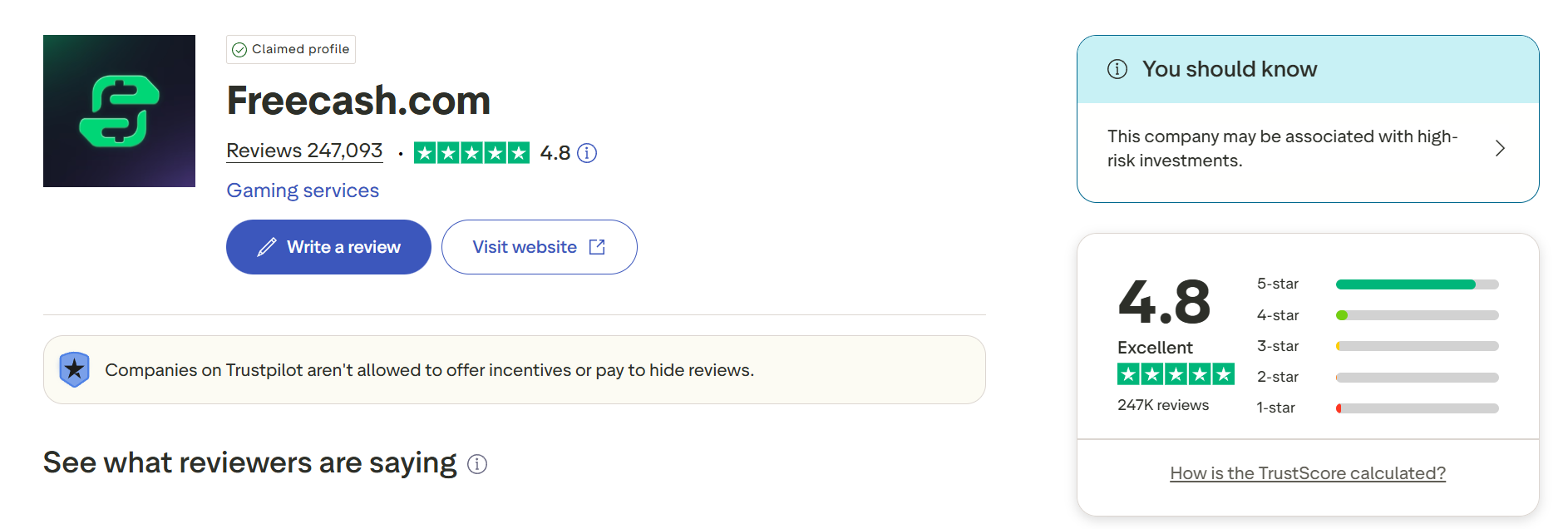
How is it even possible that, despite the complaints on other sites,
- com has a near-perfect 4.8 rating on Trustpilot?
- com has over 247 thousand reviews on Trustpilot? For comparison, the biggest email service, Gmail has 1.5 thousand reviews and a 1.7/5 rating, the biggest gaming platform, Steam has 4.4 thousand reviews and a 1.9/5 rating, and the world’s largest TV streamer, Netflix has 12.6 thousand reviews and a 1.5/ rating.
A Reddit user uncovered this particular scam:
- “There are multiple 5-star fake reviews for freecash.com listed on trustpilot. I’ve tried contacting freecash support numerous times and was temporarily banned today from their subreddit for “defamation” after posting the screenshots.”
- “While targeting legitimate 1-star reviews by replying to them, they get removed [by Trustpilot] within 3 days if you don’t answer by then. Which happens to be half of the entire 1-star review base.”
- “I’ve sent over 10 whistleblower reports on trustpilot with links to the copy and pasted reviews, none of the “invited” reviews have been deleted. Last report was December 2024. All still active”
- “Freecash support freecashhowie replied to a PM on Reddit for me stating they can’t remove “invited” reviews. . . While my 1 star “invited” review was replied to in an attempt to have it removed twice. If I didn’t reply within 3 days.”
Another user explains the low percentage of bad reviews for some services:
- “Tried to leave a negative review using Trustpilot. First it wouldn’t let me, saying there was a technical issue at their end and to try again later. When I did, I found I had been blocked. A review system that only allows positive reviews is worse than no review system.”
We found out that Robert W. Munk (LinkedIn profile), who was Trustpilot’s Global Director Quality & Compliance Operations until May 2022, is now engaged as Head of Support and Fraud Operations for Almedia GmbH, the company that runs Freecash.com.
Example: BankFive – Proven Fake Reviews
BankFive is a community bank in SouthCoast Massachusetts and Rhode Island with a “claimed profile” (i.e. paying subscription) on Trustpilot with over 5,000 reviews and a 4.7 of 5-star rating. BankFive uses the Trustpilot reviews on their website to advertise their services.
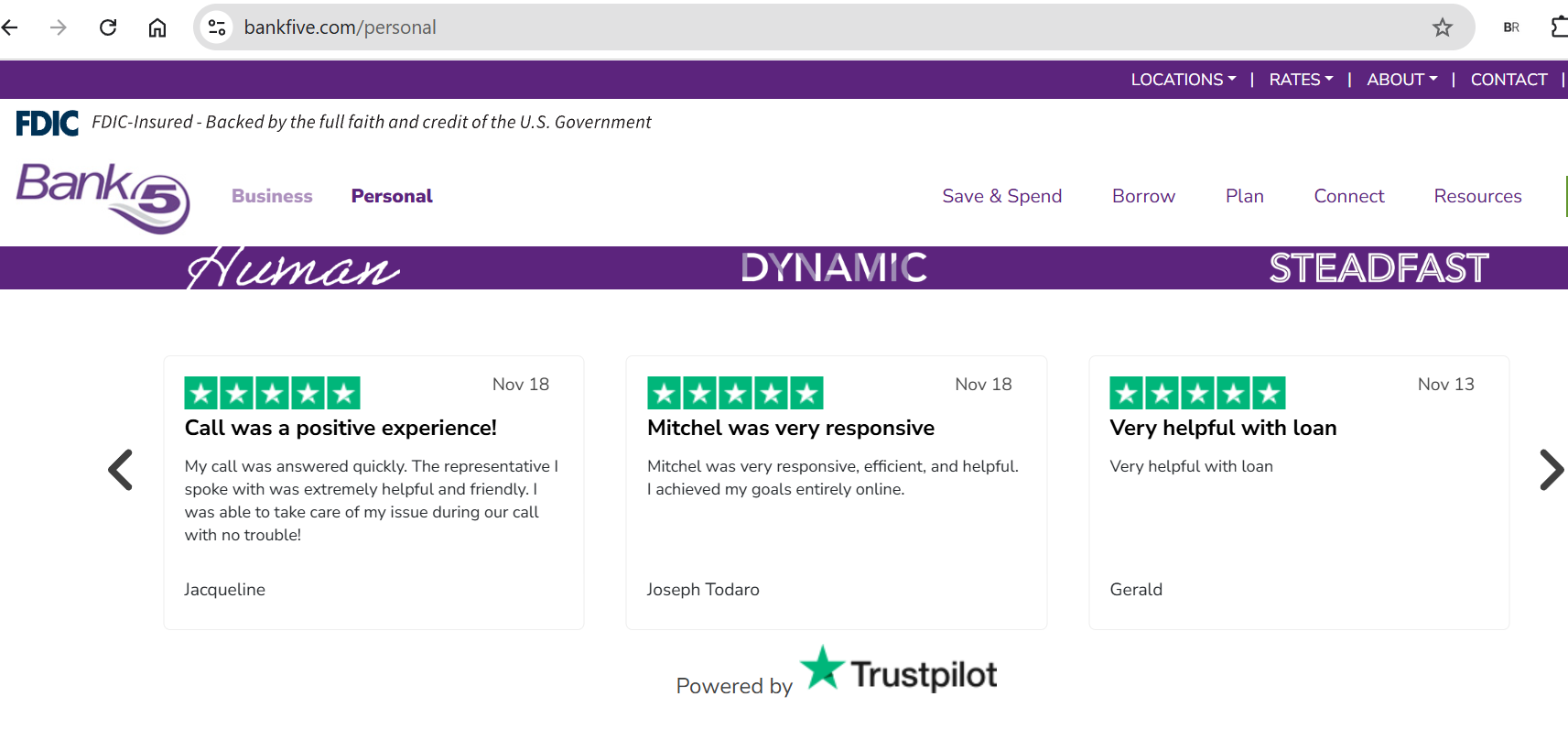
On other review sites, BankFive has significantly worse scores, with 1.0/5 on Reviews.io, 1.0/5 on BBB, 3.6/5 on WalletHub, between 1.0/5 and 3.0/5 on Yelp. Employees give BankFive average scores, as well, with 3.5/5 on Glassdoor, and 3.8/5 on Indeed. In other words, BankFive does not seem to have an outstanding 4.7 stars brand.
This data is well-explained by something we found in dark net forums: an anonymous, illegal fake review provider openly advertises with reviews for BankFive.
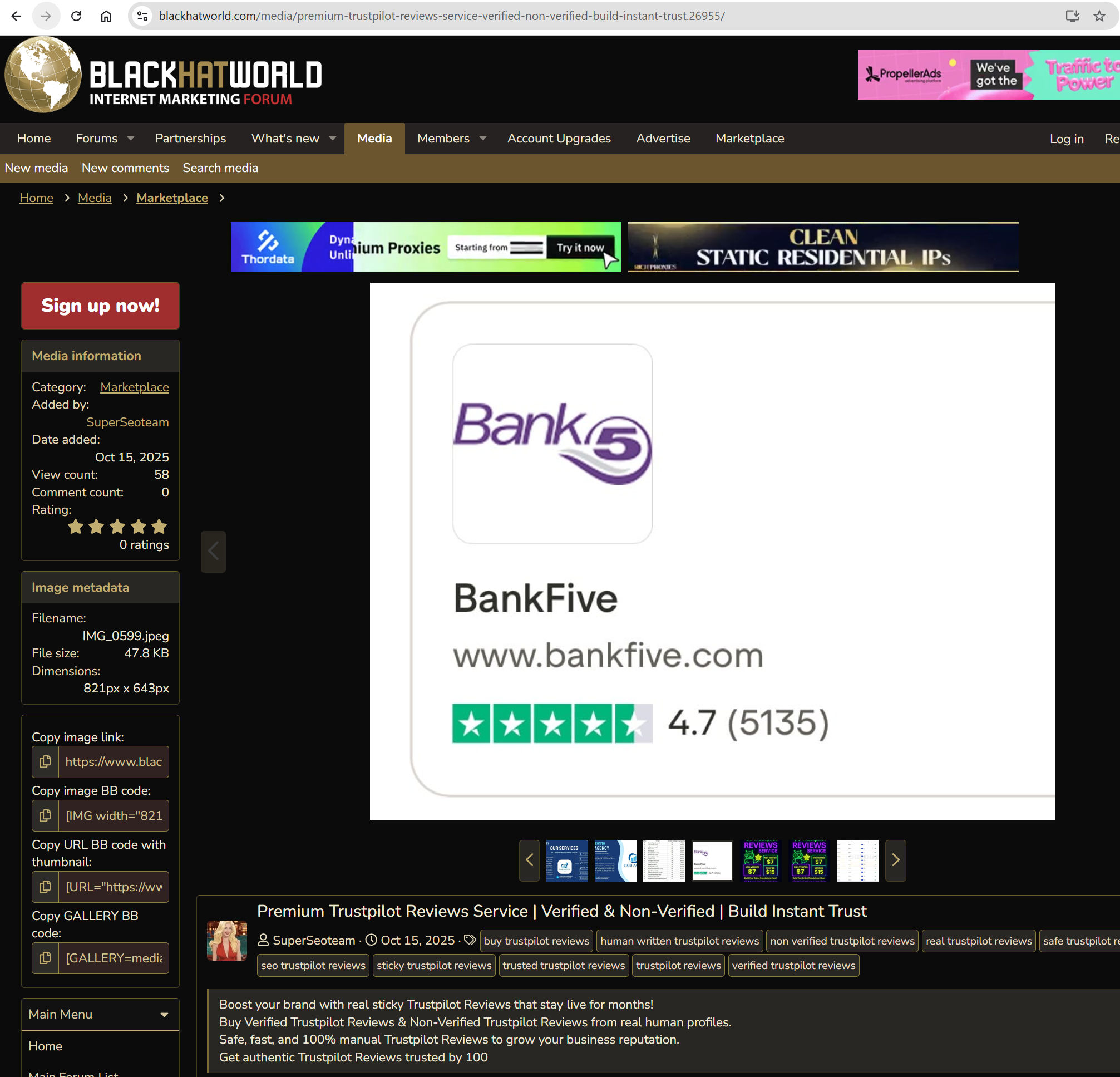
BlackHatWorld’s user SuperSeoteam indicates that BankFive is a client (Link)
A one-minute check of Bank Five’s reviews shows a clear pattern of fake reviews. Non-U.S. reviewers, for example from Bangladeshi:
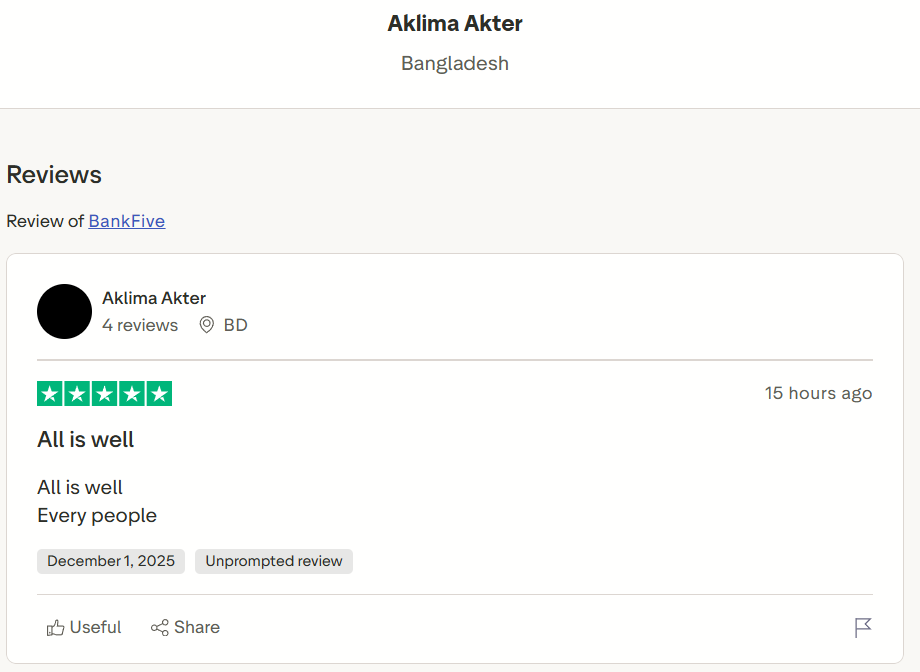
The majority of 5-star reviews for BankFive come from spurious accounts with generic first names and often several perfect reviews to BankFive, e.g. Holly, (7 5-star reviews to BankFive), Lorraine (6), Elsa (5), Kevin (5), Charlotte (4), Fernando (4), Susan (4), Linda (3), Hilda (3), and Russel (3). This is highly untypical and best explained with the style of cheap mass-production of positive fake reviews.
Example: Crypto-Benefits247 – Still on Trustpilot Even After Journalist Criticism
The Guardian’s article from October 2025 mentions the company profile Crypto-Benefits247 where the journalists flagged fake reviews and evidence of fraud, forged certificates, by Crypto-Benefits247 to Trustpilot. Trustpilot removed the flagged fake reviews and, of course, promised to be more aware of such issues. While Crypto-Benefits247’ score went from 4.7 down to 2.8 after the cleanout, it is today back up to 3.8 and the score is climbing again. A new fake review from November 8, 2025, is from an obvious fake account of user Alisa, who took a shutterstock.com image to use as an avatar, masquerading as a young woman. This user even taunts Trustpilot by giving the Trustpilot profile a 5-star review: “Thanks to the team for staying helpful.” Further fake reviews, namely by Erik Howard, Lottie Todd, Hector Forbes, and Omar Cunha, repeat this obvious pattern of pumping up Crypto-Benefits247.
Trustpilot is used once again as a vehicle to lure consumers into scam investments. This does seem unfortunately extremely common, secondly, extremely easy, and, thirdly, Trustpilot does not even follow-up on the profiles it must know are from scam companies as long as they pay Trustpilot.
Example: Swift-Financeltd – A Typical Fake Broker Scheme
Next to its 4.7-star rating the Trustpilot profile shows: “Swift Finance ltd is a financial and credit organization that specializes in providing financial services to legal entities, individuals, and corporate bodies alike. The company is involved with commercialized real estate, precious metals, petroleum, stock market, CFDs, bonds, securities, hedge funding, provision of legal loans, and venture capital investments into promising projects. We offer enthusiasts and business entities the opportunity to invest with us for a fixed return on investment (ROI) as well as the safe storage of their digital assets. The company is duly and legally registered with the United Kingdom’s Companies House as SWIFT FINANCE LTD.”
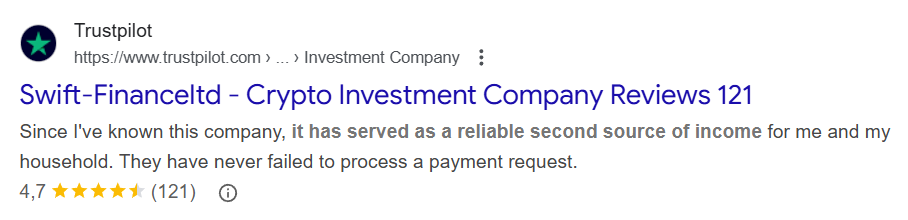
First Google search result for “Swift Finance, reviews”
Swift-Financeltd even receives Trustpilot’s best-in-category awards:
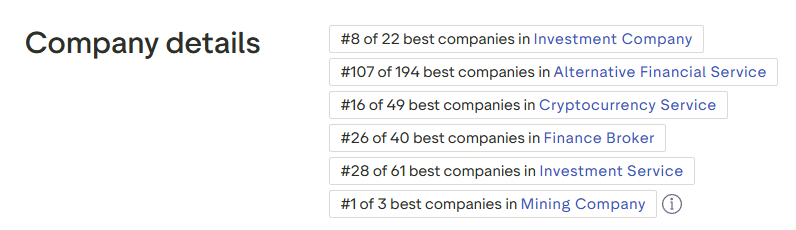
https://www.trustpilot.com/review/swift-financeltd.com
Forexbrandreviews, however, writes: “swift-financeltd.com has recently come under fire for operating as an unlicensed and fraudulent online trading platform. Marketed as a legitimate broker, this website is in fact part of an elaborate scam that targets especially inexperienced and novice traders.
Despite its professional appearance, swift-financeltd.com is not a regulated broker. It lacks authorization from any recognized financial body, making all your funds deposited on the platform extremely vulnerable.
Warning: There have been numerous complaints from defrauded clients who were unable to withdraw their money after being lured in by fake promises and fabricated success stories.
Many victims report sudden account freezes, ignored withdrawal requests, and zero customer support — all classic signs of a scam operation. The platform preys on hope and ignorance, using pressure tactics and fake guarantees of returns to deceive users.”
Reviews for Swift-Finance Ltd on Trustpilot show the typical markers of a financial scam, by users giving it 5 stars with unprecise everything-is-always-perfect-with-them rhetoric.
Example: InFace Invest Group Ltd – Yet Another Basic Ponzi Scheme
InFace Invest Group is a company based in Mahe (Seychelles), founded by Zoran Lazarević and Mladen Pejić. It claims to operate as a technology franchise company. It has a 4.2 score on Trustpilot.
According to multiple well-researched sources (mlmprevara.wordpress.com, behindmlm.com) InFace Invest Group runs a pretty simple pyramid scheme. Lazarević is a former OneCoin Ponzi promoter. Mladen Pejić is a “former police officer turned convicted drug trafficker”.
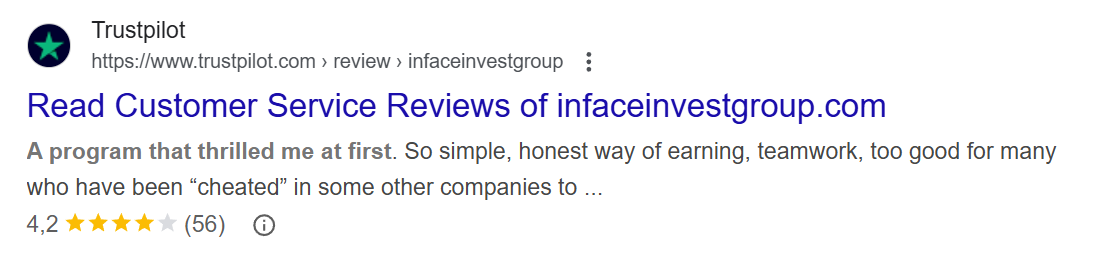
First Google search result for “InFace Invest Group, reviews”
The now defunct website infaceinvestgroup.com, still accessible via Web Archive, presents an obvious hogwash “the best business concept on the internet” and all kinds of empty technology buzz words.
The Trustpilot reviews are dominated by the usual 5-star “this-changed-my-life” fake postings.
Example: Beaxy Exchange – Yet Another Fake Crypto Exchange
Beaxy’s profile has a 4.3-stars score and its description reads: “Beaxy empowers your financial freedom by increasing your exposure to a diverse range of assets, providing you advanced trading tools, and giving direct & consistent support. Create a free account today – https://t.co/2BuOqSz7xk”
The link leads to an error page and the profile’s link beaxy.com directs to a cheap BB forum board.
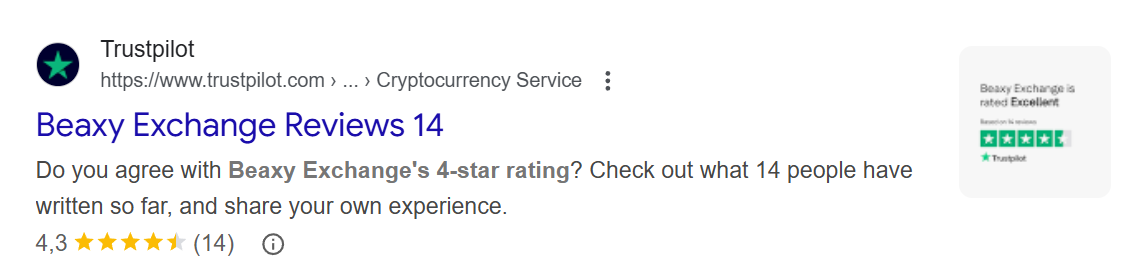
First Google search result for “Beaxy, reviews”
In March 2023, the U.S. Securities and Exchange Commission already charged beaxy.com and its founder Artak Hamazaspyan for operating an unregistered exchange, broker, and clearing agency.
Example: Mergtrade – Non-Existent Operations
Mergtrade receives 4.7-stars on Trustpilot, while its website mergtrade.ltd is offline. Its profile says: “mergtrade.ltd is a world leading investment firm that offers various investment services to individuals and corporate bodies alike for the sole aim of profit maximization through cryptocurrency. Our company is involved in financial activities including but not limited to Forex, Stock, Agro Farming, Nft, Bond, Oil & Gas, Real Estate Investment, Loan, Private Equity funds and largely, Cryptocurrency Trading and Cryptocurrency Mining. Earning with mergtrade.ltd is a legit, genuine, and hassle-free path to financial stability.”
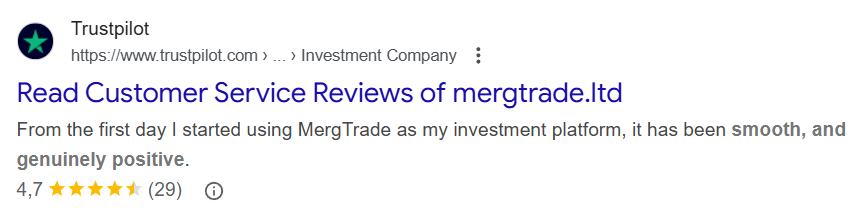
First Google search result for “Mergtrade, reviews”
The only website snapshot on archive.org is from December 2024 and shows a 404 error, i.e. there was nothing on that website. A Google search also shows no other traces of any operations by a company called Margtrade. Thus, it seems Mergtrade never engaged in any operations.
However, the Trustpilot profile shows plenty of 5-star reviews, most of October and November 2025. The reviews show the typical too-good-to-be-true fake rhetoric.
Example: Tradenova
Another example is Tradenova, which currently has a 3.6-star rating with only 9 reviews. They describe themselves as offering “crypto insurance solutions that enable you to protect your investments, wealth, style of living and loved ones.” Once again, the FCA published a warning people to refrain from dealing with this company as it not authorized by the regulator to provide the services it advertises.
The Typical Fake Review Patterns
Review scores on Amazon, for comparison follow a so-called J-shaped distribution. The phenomenon is well researched and established in business and academic research.[1]
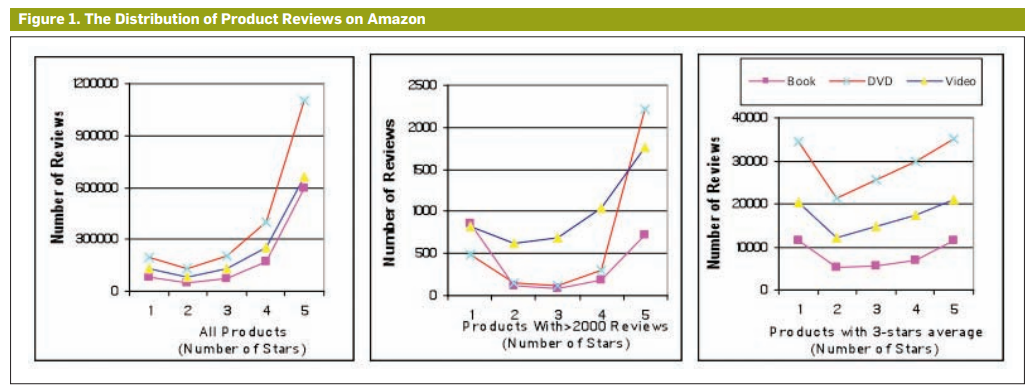
https://doi.org/10.1145/1562764.1562800
This shape implies that well-liked products have a majority of 5-star reviews, and the lowest amount of 2- and 3-star ratings. 1- and 4-star ratings are more common than 2- or 3-star ratings due to polarization about the product. In Trustpilot’s data, for brands with tens or even hundreds of thousands of reviews, we rarely find this pattern sufficiently clearly exemplified. Review data for subscribed businesses on Trustpilot follow in many cases an _I shape, meaning that over 80% of reviews are 5-stars and there is no meaningful pattern of reviews sorting below the 5-star threshold.
Widespread Evidence of the Trustpilot Mafia Scheme in Online Forums
The Trustpilot Mafia scheme is known among many businesses. The following Reddit post provides another good summary of the scheme:
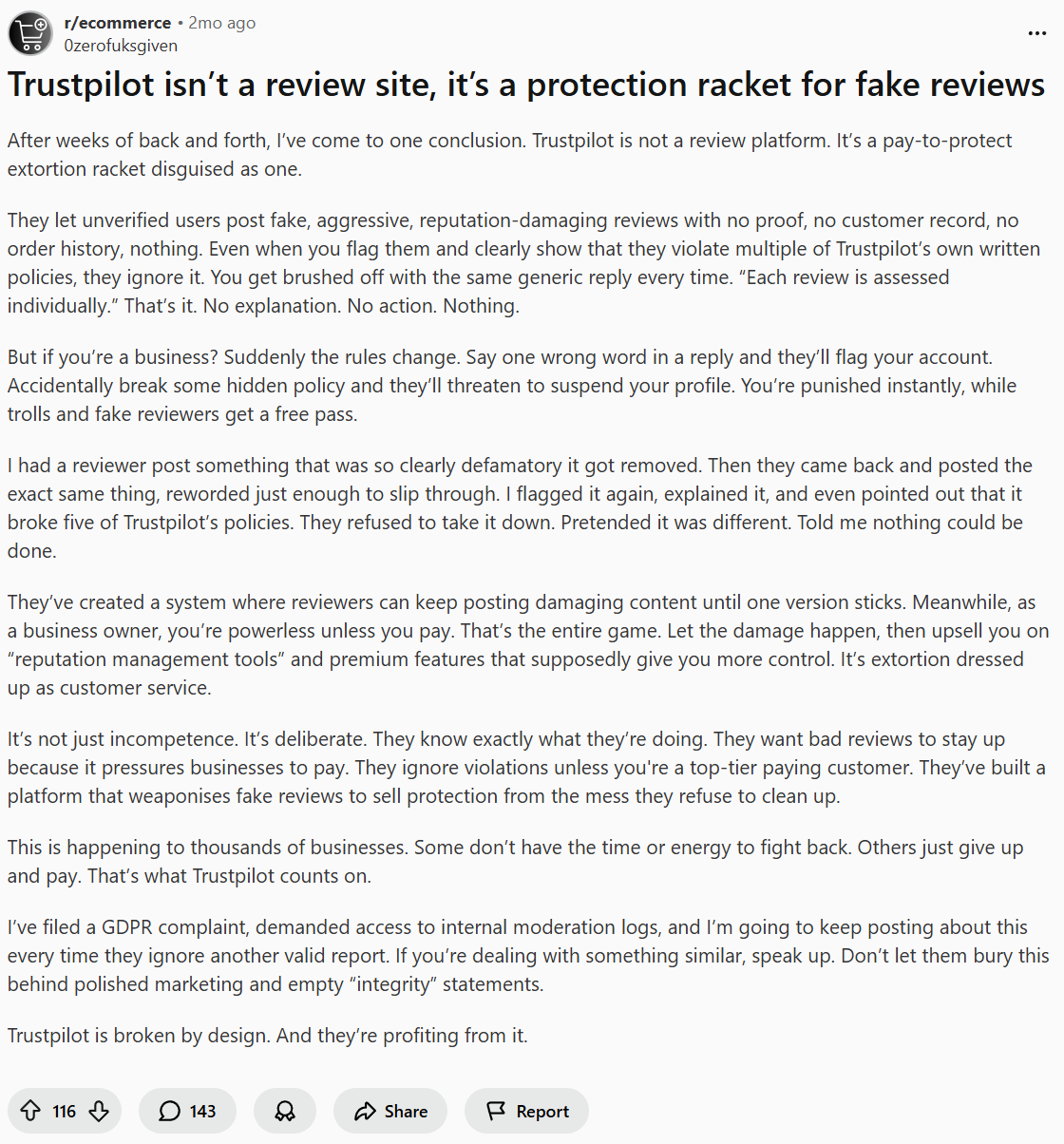
A Quora post claims “Trustpilot has been removing thousands of genuine reviews without investigation simply because they have been flagged by companies deceiving Trustpilot to get rid of negative reviews and keep high rating.” Trustpilot themselves is obviously aware that these removed critical posts are likely by genuine clients. Another Quora thread provides further examples of removed genuine reviews.
The British company Baskets Galore explains how they are victims of the Trustpilot Mafia scheme in a dedicated podcast episode.
In June 2025, an Australian tech journalist, in his blog, describes Trustpilot as a “Joke – A Playground for Fake Reviews, Shady Tactics And Scammers”. Thousands of businesses buying fake 5-star reviews via freelancers, agencies, or black-market services. The site ignores obvious patterns while aggressively removing legitimate negative feedback, allowing scammers to “lure victims with forged trust badges and stolen identities.” Trustpilot is profiting from the chaos by charging businesses to “protect” their profiles, turning it into a “shady ecosystem” where authenticity is “non-existent.”
Back in 2022, a blog commenter already describes a detailed case of the scheme: “Last year I emailed them many times regarding a company by the name of Maxen Power, they employ staff based in Pakistan whose sole job was to write fake and bogus reviews (their own employee told me this). I asked Trustpilot to check the IP addresses of the positive reviews and informed them 99% would be from the same address. They emailed me back to say they would investigate my complaint but 7 months on the FAKE reviews are still there and Trustpilot has done nothing about it.” Another commenter ads: “The Maxen Power that ‘Legit Blogger’ refers to have, in the last 12 months, “flagged” ONE HUNDRED AND THIRTY reviews – over 25% of the total received – every one of them was a one star review.”
In January 2025, the CEO of BuySellAds.com describes on Twitter/X how Trustpilot unfairly removes positive reviews but never negative reviews. In June 2025, the U.K. company ADVICIFAS writes: “For years, we tolerated Trustpilot’s shady practices, robotic customer service, and overpriced subscription model in the hope that they might evolve into a fair, transparent platform. But after seeing firsthand how they’ve enabled malicious, fake, defamatory reviews, extorted small businesses, and used AI to silence legitimate complaints—we’re done. Finished.” Some further quotes from the article:
- Ryan Badger — “Trustpilot promises to be ‘free and open’ — in reality, they are the exact opposite, holding companies at ransom, and outright violating their own terms, as well as the law.”
- Rishi Chowdhury — “Trustpilot has become a joke. Spam reviews, fake claims. They don’t care about small businesses anymore.”
- James Williams, Digital Marketing Consultant — “Flagged fake reviews that were clearly spam. Got auto-responses and nothing removed. Meanwhile, legitimate reviews were taken down.”
Web hoster RSH writes in an October 2025 post “All those website that advertise “2000 reviews on TrustPilot” “5 star rating out of 10,000 reviews” THEY ARE ALL PAID FOR”
A blog post from 2024 describes how legacy publisher Penguin-Random-House suddenly “found themselves under siege by a sudden influx of negative reviews on Trust-pilot—reviews that its management believes are fake.”
A user in 2021 summarizes on YCombinator’s forum: “TrustPilot is a form of near-perfect evil. If someone leaves a negative review of your business on TrustPilot, you can have it taken down… for a measly $400 per month. If you refuse to purchase their premium package, they can prioritize the negative review to be shown above the positive ones until you do. If your competitor hires a review-bombing spammer to add negative reviews en masse, well, you’ll just have to upgrade to the next-tier plan.”
Media Supports our Allegations
Fake reviews and scam businesses on Trustpilot have been reported before on mainstream media channels. Trustpilot reacted to these by removing the flagged accounts and promising to better its standards. In our report, we demonstrate that the current state is fundamentally a fraudulent enterprise at its heart.
In October 2025, The Guardian reported an investigation about “suspected scam investment companies are exploiting Trustpilot’s review system by giving themselves five-star ratings to persuade would-be investors that they are legitimate businesses.” Trustpilot is given space in the article to claim that these issues are rare occurrences and Trustpilot will strengthen its processes.
In May 2021, the BBC aired a story about unfair removals of bad reviews on Trustpilot.
Conclusion
Trustpilot always faced a fundamental conflict in its business model as a third-party review site that generates its revenues from selling subscriptions to companies. Trustpilot must balance the integrity of its reviews with the value they can provide to paying businesses. We see simply not enough revenue potential in advertising or value in marketing analytics to sustain the business. We conclude Trustpilot has failed to balance this conflict, and, due to pressure to present investors with growing revenues and profits, has now gone all in on becoming the extortion racket that we describe in this report. While extortion tactics might boost revenues in the short term, they lead to a rapid degradation in the value proposition for website visitors who want to get objective reviews when researching a service. In fact, we ourselves have used Trustpilot as an indicator in past reports to gauge customer satisfaction. We now have lost trust in the integrity of the Trustpilot brand and believe that it is only a question of time until the public does, too. Once the depth of the issues is understood the Trustpilot website is bound to see less visibility on Google, which will be the final nail in the coffin for a business that we see doomed to fail.
__
[1] E.g. Kovacs, Balazs. (2023). TESTING THE EQUIDISTANCE OF STAR RATINGS IN ONLINE REVIEWS. Organizational Research Methods. Chatterjee, Ishani & Abusorrah, Abdullah & Sedraoui, Khaled & Alabdulwahab, Ahmed. (2021). Statistics-Based Outlier Detection and Correction Method for Amazon Customer Reviews. Entropy. 23. 1645. 10.3390/e23121645