
- Nexstar is a U.S. television and radio company, owning nearly 200 nation-wide and local stations with associated digital platforms
- Since revenue from traditional TV is generally declining, the entire broadcasting industry’s equity trades at steep discounts and investors expect a convincing digitalization strategy
- To impress investors, Nexstar mentions “digital” 64 times in their latest annual report and touts their “assets include 138 websites and 229 mobile applications across our local stations, NewsNation and The Hill. The portfolio also includes eight connected television applications and three free ad-supported television (“FAST”) channels from The CW and The Hill.” Nexstar’s shares trade close to its all-time high and at a hefty premium against competitors.
- We took a closer look and found that web traffic, app downloads and overall interest in Nexstar’s digital offers are rapidly declining throughout the whole portfolio. Their digital offers are mostly technically outdated by a decade or so.
- We interviewed sixteen former Nexstar executives and directors, who all expressed great frustration regarding Nexstar’s poor digital strategy. All of them—without exception—see Nexstar in deep trouble. We have never experienced such a consistently negative sentiment by insiders about any of the companies we researched. The most common issues raised were:
- Nexstar’s digital strategy is mostly virtue signaling to investors by acquiring digital businesses with great fanfare, and no serious strategy by a “fake it till you make it management class”
- The leadership seems oddly ignorant of all new media technology
- The leadership is propping up hopes for a linear TV future because Nexstar could never make their digital assets work
- Current earnings are reported on the back of extreme underinvestment in new technology and employees; instead, Nexstar bought back stock and paid dividends to appear financially strong
- 2024 was an unusually good business year due to political ads but this gravy train is drying out since Trump won mostly through social media like Joe Rogan’s podcast
- Acquired digital assets are underutilized and development is usually stalled—expensive assets like BestReviews.com serve no function; apps and websites are outdated
- Nexstar lacks far behind direct competitors regarding its operational technology
- The leadership wants to “ride-out” the remaining cash flows from linear TV until they personally retire soon
- No strategy or even interest is in place to attract a younger audience
- One former executive said that Nexstar has only “one and a half year of stability” left
- Nexstar Digital has a record low of 2.3 of 5 stars on Glassdoor from 102 employee reviews, because insiders know about the terrible quality of the company
- Many of Nexstar’s digital assets are barely used. Most of the assets with users see strongly declining engagement.
- The CW, Nexstar’s key asset for entertainment to younger audiences, declined by between 76% to 95% in user interest, web traffic, and app usage
- com, Nexstar’s key digital asset for consumer insights, audience growth and monetization are basically sidelined with only 6% of former web traffic left
- Other large digital assets for Nexstar, by The Hill and NewsNation have seen a decline in traffic and interest over the last two to three years, with decreases ranging from 20% to 53%
- While leading media apps are rated between 4 and 5 stars in the app stores, Nexstar’s apps rate far below 4 or even 3 stars due to them being technically outdated
- Most Nexstar apps are localized news and weather apps with barely any downloads
- The 138 websites and apps are almost all content platforms from the same outdated boilerplate design with strongly declining overall interest
- While Nexstar has uploaded hundreds of thousands of videos on its YouTube channels, most of these videos have barely more than a few thousand views. On average, a Nexstar video on YouTube creates less than $10 of income per year.
- Interest in other national Nexstar brands is down massively in web traffic (-73% to -94%) and Google Trends (-30% to -94%) from their peak
- Studies show that consumers prefer social media platforms for news. As a result, local news station companies, like Nexstar, have continued to lose their audience
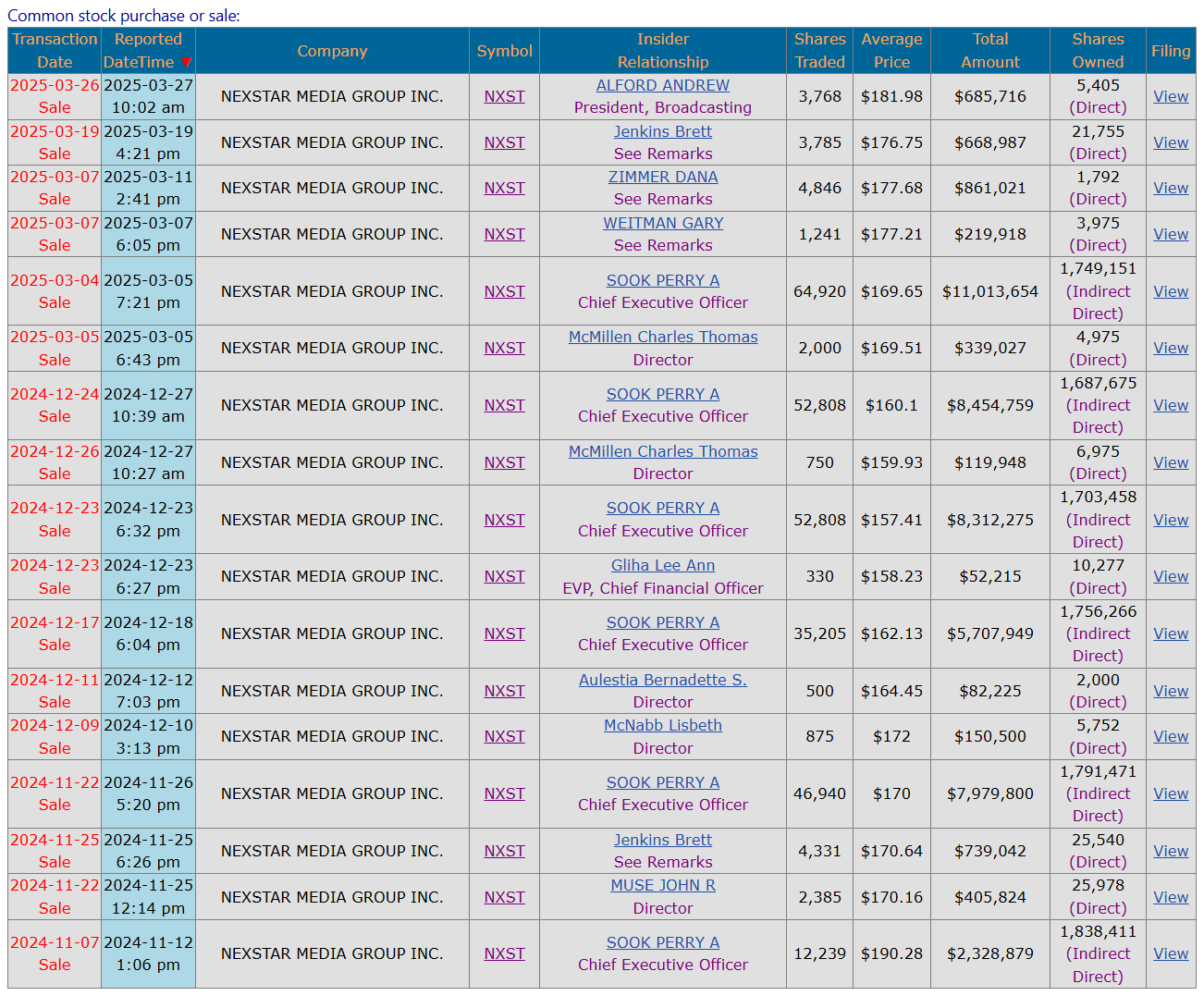
- Our negative sentiment is supported by insiders aggressively selling shares during a time when the company buys back shares
- From past acquisitions, Nexstar reports $2,922M in goodwill at a total shareholders’ equity of only $2,242M. We believe a substantial portion of this goodwill should be written off, given the terrible future prospects of Nexstar’s business.
- In conclusion, Nexstar may not benefit from its legacy TV business for as long as it expects, and the company appears unable to effectively pivot its strategy to the highly competitive and rapidly growing digital market.
Introduction
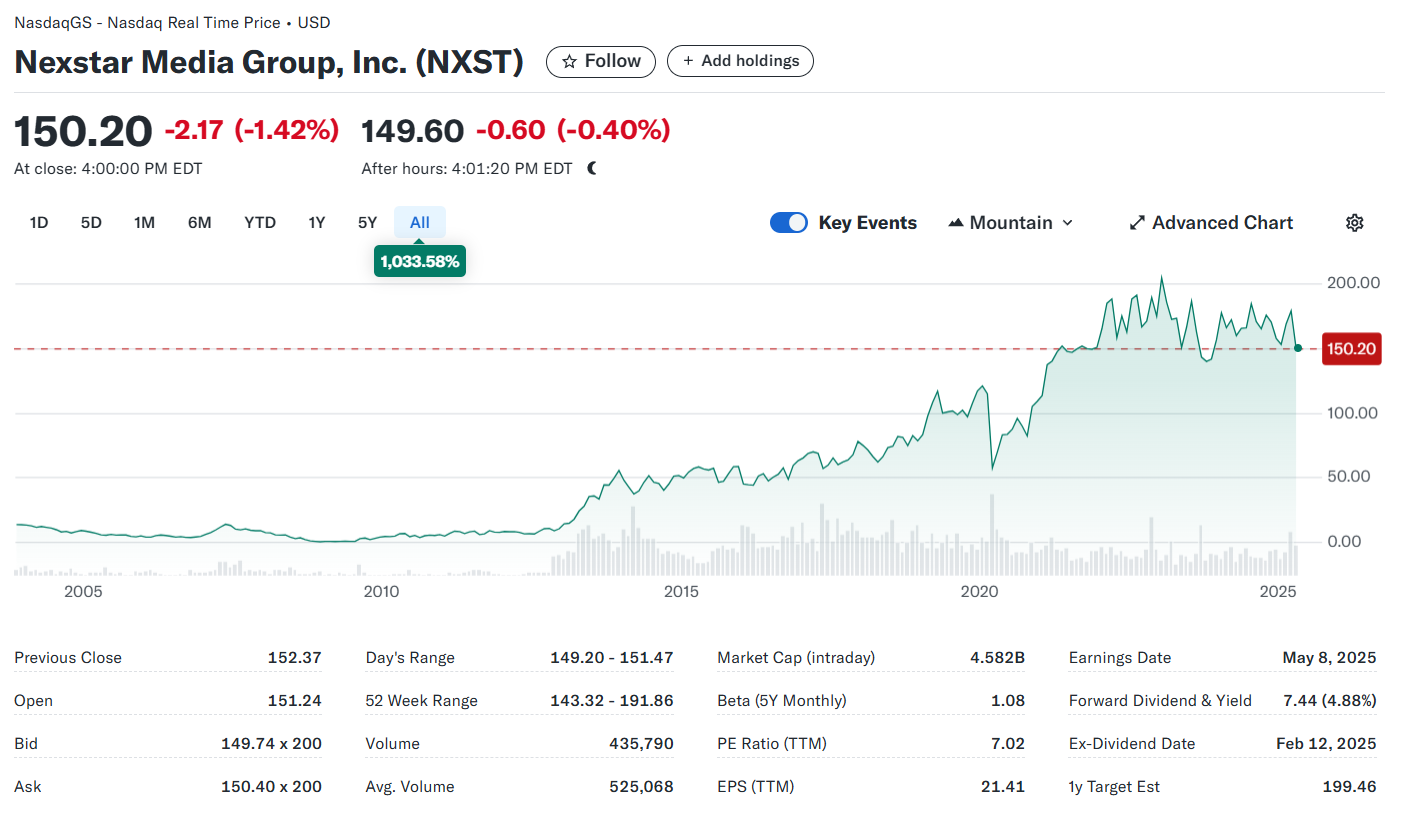
Nexstar Media Group, Inc. (Nasdaq: NXST) is a media company that produces and distributes local and national news, sports and entertainment content across its television and digital platforms. Nexstar owns America’s largest local television broadcasting group comprised of network affiliates, with more than 200 owned or partner stations in 116 U.S. markets. Linear TV is declining nationally and locally, resulting in media companies needing a convincing digital strategy. Nexstar’s portfolio of digital assets include 140 local websites, 278 mobile applications, 25 connected television applications, and six free ad supported television (“FAST”) channels.
Linear Broadcast TV Is Having Its Kodak Moment
Nexstar currently generates the lion’s share of revenue from linear broadcast TV, without providing detailed separate numbers in revenue reporting. A May 2024 study summarizes that for those still watching linear TV, which is described as “the traditional form of television…programmed and watched as scheduled through satellite or cable and is not streamed to a specific user on demand,” the average age is 64 ½ years. The same study shows that Nexstar’s The CW averages out at 65.2 years of viewership age.
Nexstar’s old viewership implies two major problems. First, traditionally, the advertising industry targets an audience under 50 years of age, because these are statistically much more susceptible to advertising. A recent study by YouGov from October 2024 shows again that millennials and Gen Zs are most open to and influenceable by ads. Second, Nexstar’s audience is simply dying out quickly without new viewers showing any interest in linear broadcast TV.
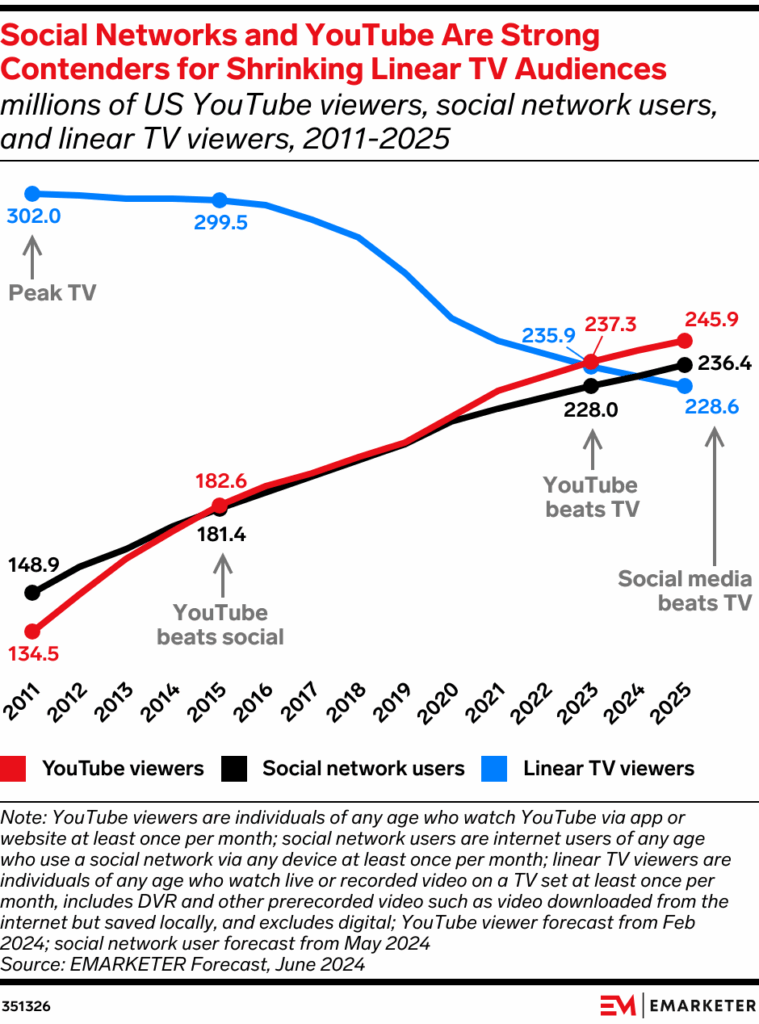
The big and fast shift from linear to web. Source: emarketer.com
Coinciding with the trend, since 2021, Nexstar’s NewsNation, has seen its household reach decline significantly, falling from 75 million to just 64 million over three years — a nearly 15% drop.
The combined effects from an audience that now becomes too old for advertisers and the big shift from linear TV to web content, catalyzes a Kodak Moment for Nexstar, similar to when the introduction of digital cameras destroyed Kodak’s business model completely within a few years. This is why investors are expecting a convincing digital strategy from legacy TV companies because investors understand that traditional linear TV is quickly dying.
The insiders we interviewed expressed the consensus that Nexstar’s leadership and investors underestimate the speed of the industries’ transition to digital. One even said Nexstar has only “one and a half year of stability” left.
Nexstar’s Digital Expansion by Acquisition Spree
Nexstar grew its digital business mostly by acquiring companies in the field.
- In 2012, Nexstar acquired Inergize Digital Media to get its hands on their integrated suite of services for content delivery across various screens, including apps, mobile platforms, and websites, backed by a content management system. The deal included twelve TV stations and cost $285.5 million.
- In March 2014, Nexstar also acquired Inergize’s direct competitor, Internet Broadcasting, for $20 million.
- In May 2014, Nexstar acquired Enterprise Technology Group, a provider of cloud-based content management, engagement, and monetization solutions for an undisclosed sum.
- In 2015, Nexstar acquired Yashi, a leading location-focused, video-advertising and programmatic-technology company, for $33 million.
- In 2015, Nexstar acquired Kixer, a digital marketing technology company for an undisclosed sum.
- In 2017, Nexstar acquired the leading digital video advertising infrastructure platform, LKQD Technologies for $90 million.
- Nexstar’s 2017 acquisition of Media General for $4.6 billion (and previously, Media General’s merger with LIN Media) added a suite of digital marketing and ad tech businesses.
- In 2019, Nexstar acquired Tribune Media for $4.1 billion plus $2.5 billion in assumed debt. The deal included Tribune’s digital assets with “a variety of digital applications and websites commanding 54 million monthly unique visitors online.” (com)
After a number of acquisitions in 2015, Nexstar merged its then digital management assets into a company called Lakana to “work with publishers to eliminate the friction and complexity of their digital businesses so that they can focus on engaging audiences and maximizing revenues across every available channel”. Lakana was not only serving Nexstar, but also many of its competitors. With its latest available webpage snapshot in May 2019, Lakana seems to have been silently shut down and merged into Nexstar Digital. Nexstar continued its purchasing spree.
- In December 2020, it bought BestReviews – a leading consumer product reviews website – for $160 million.
- In August 2021, Nexstar acquired The Hill, a prominent digital politics and policy news platform, for $130 million.
- In 2022, Nexstar acquired a 75% stake in The CW Network for roughly $100 million net by assuming debt. The acquisition was a cornerstone of Nexstar’s strategy to become future-proof. In June 2023, The CW published their “purposeful strategy to bring new viewers to The CW with different flavors of content that will attract more people. The most singular goal is to get bigger and broader.”
Nexstar Trades at a Hefty Premium
Due to the audience decline, classical linear broadcast businesses generally trade at a suppressed valuation relative to the general market.
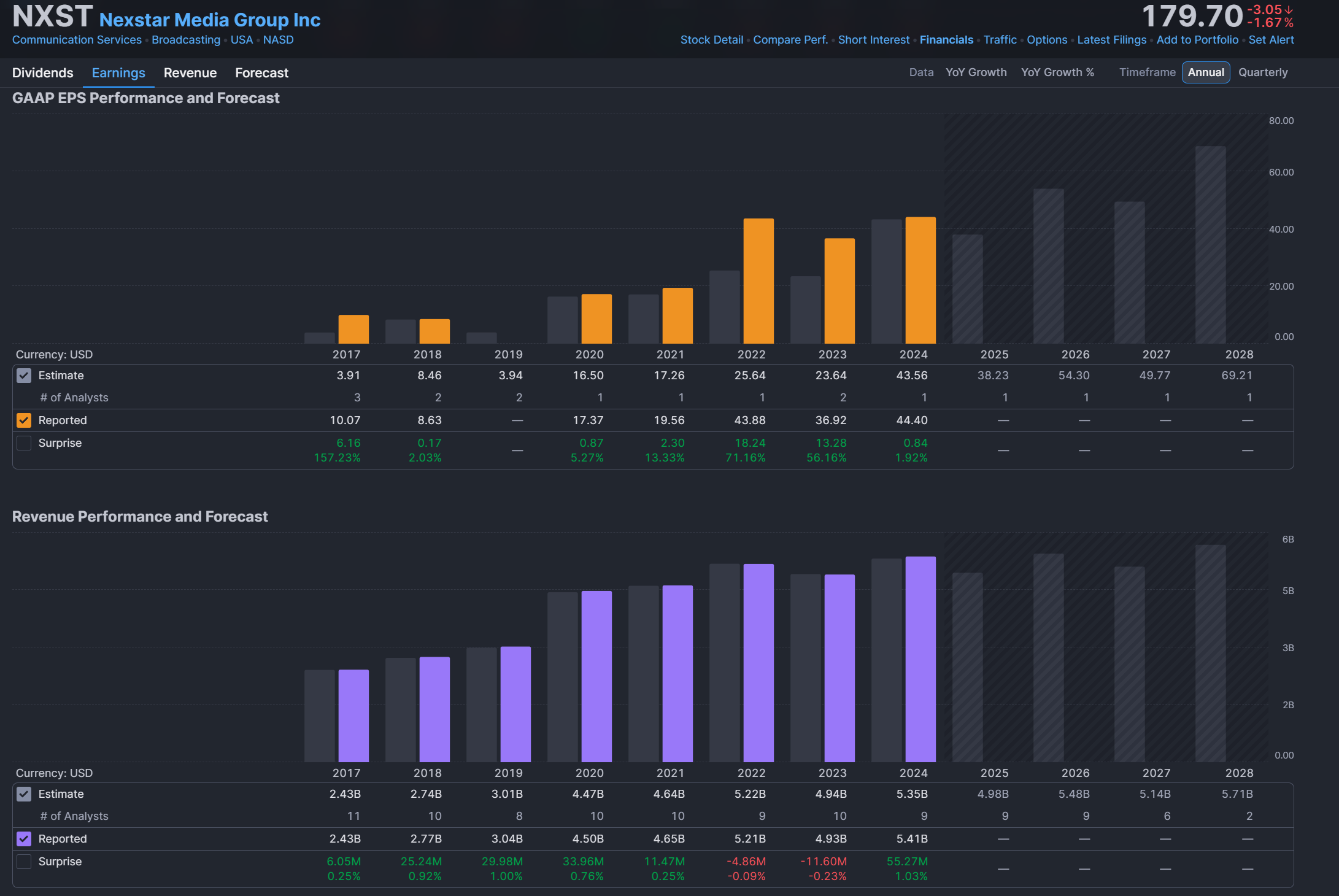
Nexstar’s touted digital growth strategy and recent history of profits due to underinvestment are reflected in valuation multiples that are higher than those of most listed competitors.
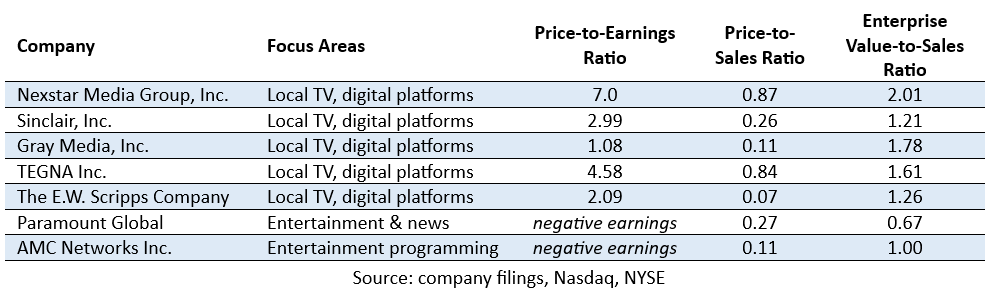
The main takeaway from this data is that all legacy broadcasting companies try to execute strategies to divest or hedge their legacy broadcasting assets with digital growth strategies, but only convincing strategies give investors the confidence to pay the premium we observe for Nexstar and, to a lesser degree, TEGNA and Sinclair.
Nexstar Boldly Presents Itself as a Digital Leader, but Insiders Disagree
Nexstar’s unit for their digital business, Nexstar Digital, presents itself as the home of “expert data scientists who deliver a data-driven proprietary omni-channel advertising technology by diverse, innovative, and eclectic minds to optimize your media spend on national and local TV broadcasts, websites and apps.” (nexstardigital.com, nexstardigital.com/stellar/)
Industry awards presented by Nexstar. Source: nexstardigital.com
Commenting on the latest earnings announcement on March 2, 2025, investment analyst Wesley Park summarizes analysts’ perception
“Nexstar’s diversification into digital media and technology through Nexstar Digital has been a smart move, enabling the company to tap into new revenue streams and adapt to the changing media landscape. Analysts praise this strategic decision and anticipate further growth in Nexstar’s digital segment.”


User comments on Nexstar’s March 2, 2025, earnings release
Recently, At the Morgan Stanley Technology, Media & Telecom Conference on March 5, 2025 Nexstar’s CFO Leanne Glia emphasized in front of investors that “local digital is something that we’re incredibly focused on as a company.”
All Sixteen Nexstar Insiders We Interviewed Were Extremely Concerned About Nexstar’s Near Future
We consulted with sixteen former insiders of Nexstar that consistently portrayed the image of a failing company. None of these insiders believe that Nexstar is on good track with its current strategy. We have never seen such a consistent and negative sentiment from all interviewees. Here is a collection of the most important concerns with some original interviewee quotes.
Nexstar’s high stock valuation is unjustified. “I don’t see what puts them into such a greater position than everyone else. I think all local media companies right now, based on the strategies that I’m seeing them deploy, are just vulnerable.”
Only 1.5 years of stability are left. “Perry will retire in a couple years and the next person that takes over the company will have to deal with the mess and it will take a massive dive. So it may stay at that level for another year and a half.”
The decline in digital traffic is a massive issue. From all formers we heard concerns in similar direction than the following example: “The decline is deeply problematic for Nexstar’s business model — both mid- and long-term — because digital growth isn’t just a supplement anymore, it’s a necessity”
The leadership is completely ignorant towards everything digital. “They feel like everything digital, and streaming is plateauing soon”; “Nexstar has little strategy or capability to address the decline. There is no active plan in place to adjust to where the eyeballs will be in years to come.”; “There is not even a strategy to find the viewers with the news content where they are. So there is no Instagram strategy, there is no TikTok strategy, there is no Snapchat strategy”
No interest in young audience. “They don’t have a strategy to attract more young users”; “It was like they almost discouraged social media, and I don’t think they really care to grow with a younger audience”
The old revenue model dies. “Half of their broadcasting revenue was from retransmission, but as we know now, we are seeing a trend of cable-cutting.”; “It’s not nearly as profitable to advertise to people who are over 49”; “I would assume the usual local station news consumer is 40 to 70 year olds. So, most of the viewership when it comes to ads measured at value is worthless”
Advertisers leaving Nexstar. “The advertising environment is so broad now that there are so many ways to advertise that customers no longer use groups like Nexstar”; “Most advertisers expect a robust digital mix as part of their marketing solutions”; “There are not a lot of people that are buying Nexstar’s digital properties. And when advertisers were testing the water by buying digital advertising, about 70% of them only did one campaign and never came back. And Nexstar has no capability of tracking the loss of why.”
Nexstar’s leadership is just too old to get the necessary trends. “Like the broadcast television side, I think the challenge that they face now is that the leadership team, it’s their age and they’re kind of aging out because they’re not in the loop. It’s going to require a fundamental shift of thinking at the top. My concern is that I just don’t think they’re capable of making those decisions. Because I just believe that those guys are all timed out.”
Poor digital acquisition just for show. “Certain things [CEO] Perry did to appease the board. This was around the same time as Best Reviews and the Hill. Those were to show the board that Perry was making digital investments and not just linear.”
Nexstar underinvests today to report good profits. “They have no future because they’re not investing where the other companies are making some interesting and significant investments. That’s why they report good profits today.”; “When they hired the new Chief Digital Officer from Roku, the strategy was to become the next Tubi. However, the budget was slashed due to ongoing financial misses, so most of the larger growth plans were shelved.”; “People that could actually drive innovation on next level research capabilities have been let go”; “They put almost nothing into their marketing strategies”
The digital product is outdated. “The interface is outdated and isn’t received as open to both spectrums of users – young and old.”
Nexstar cannot compete with digital giants. “And I just think that they need to really start coming up with creative ways to position their products relative to the objectives of the advertisers. Because you know, Facebook and Google are eating their lunch.”
Outdated Sales technology. “The sales tools and the software and the capabilities to enable the sales team to go out and monetize The Hill are subpar compared to what Sinclair, Tegna, Gray and Scripps have today”; “Nexstar purchased 1,600 Salesforce CRM licenses but then decided not to use it. They’ve been trying to negotiate with Salesforce to get out of the deal. But Salesforce obviously is not going to stand down the deal.”
Digital innovators get kicked out. “If you have some guy and he presents this is going to change the world and linear is dead. That whole conversation just ends immediately. You have a very short shelf life in the company and then you’ll be gone. They then need to have someone come in and speak about digital using the same language and monetization strategies as linear and let them know it’s not that vastly different.”
Poor operations. “The editor of the Hill, the previous one, just left five months ago and he was only in seat for I think a year and a half before he got frustrated with the lack of support and guidance from there. And that really hurts. That Hill sales team, their sales strategies, not great.”
Nexstar’s unit for its digital operations, Nexstar Digital, has a record low 2.3 of 5 stars on Glassdoor from 102 employee reviews. These reviews corroborate the same issues our interviewees highlighted:
“Those jokes about helping your grandmother get on “The Twitters?” That’s this company’s digital operations. Nexstar as a whole doesn’t understand digital advertising and doesn’t want to, but needs to have something to talk about with investors who keep seeing drops in local television viewership and customers who “want some ads on that FaceChat my niece is always on.”
“They had no idea what they were doing”, “ Nexstar leadership is terrible. They could care less about their people and are out of touch with digital.”
“The company hired the fake it to you make it management class. These people did not have any expertise in digital advertising and wasted millions of dollars and many employee hours on product Dev and service integration that went nowhere. They had no focus because the leadership was too ignorant of the technologically they were trying to implement.”
“They let our back-end technology rot and slowly strangled the company out of existence.”
Nexstar’s Digital Assets Perform Poorly Despite Nexstar Telling Investors the Opposite
Nexstar acquired or built several major digital assets over the last decade. While these assets dramatically underperform in recent years, Nexstar has not issue any warning to investors. On the contrary, Nexstar tells investors the company is well-positioned for a digital future.
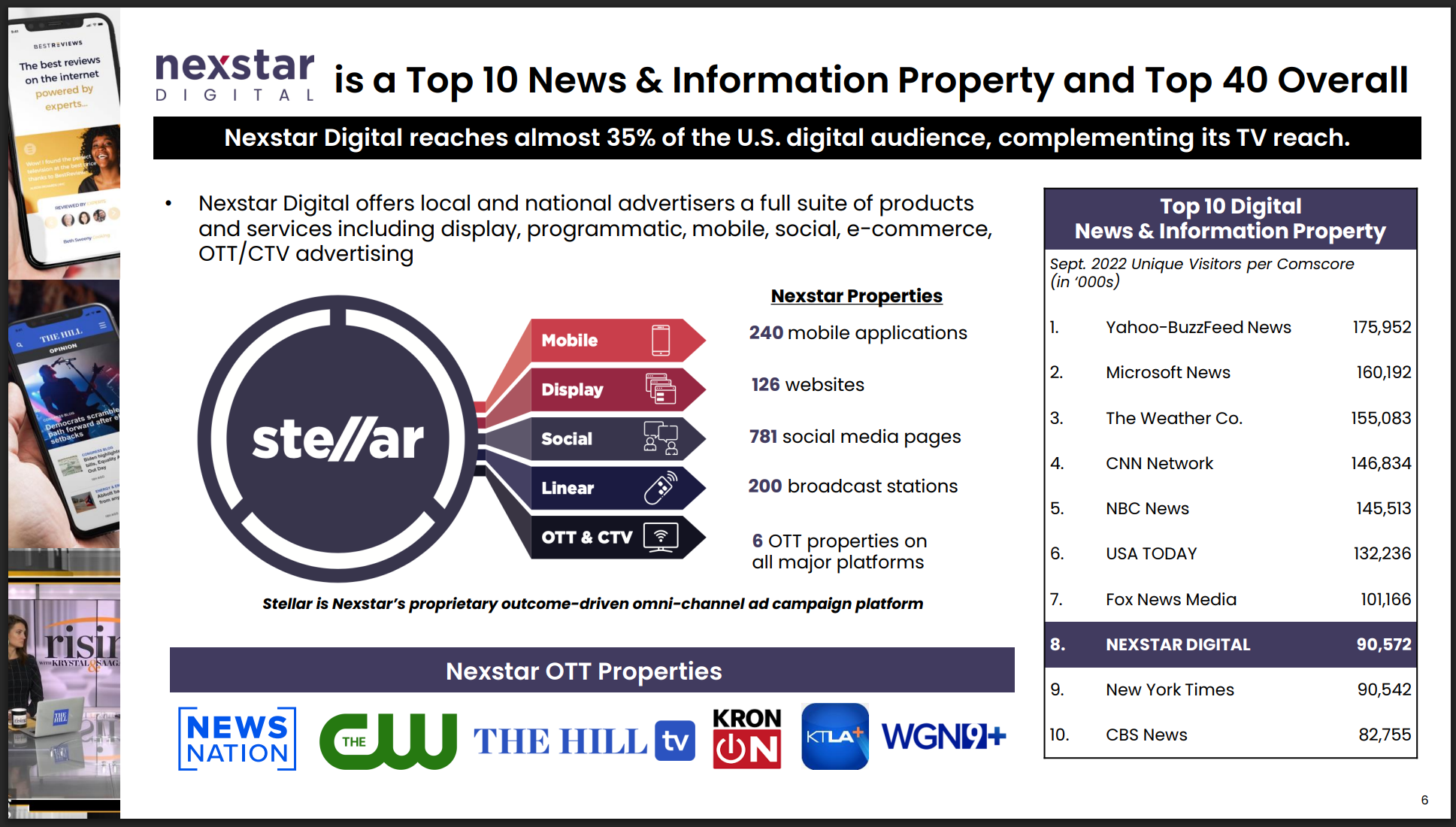
Nexstar tells investors it’s digital unit is well-positioned for the future (source: latest investor deck, 2023)
We analyzed each of the hundreds of digital assets in Nexstar’s portfolio. In the following, we show how bad the engagement numbers of these are and how fast they get even worse.
National Mobile Apps
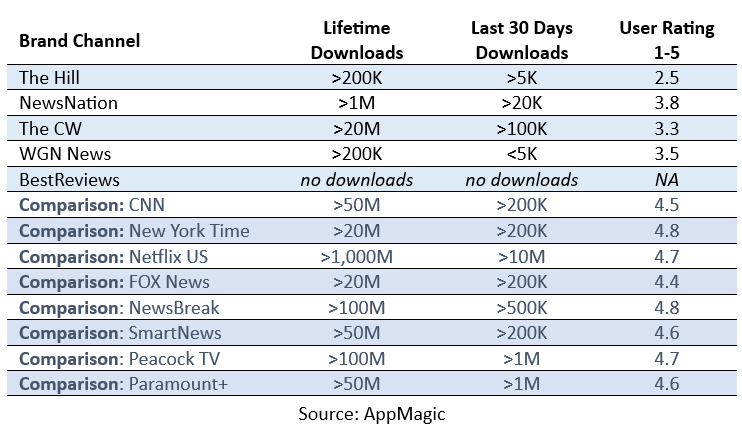
The mobile apps by Nexstar Broadcasting have extremely low download numbers since their releases that were in most cases more than a decade ago. One reason for the low download numbers is technical difficulties users experience with the apps. For reference, good media apps score above 4.5/5 stars in app stores by Apple and Google. The picture is similar for the other 297 apps, which mostly are local news or weather apps with an outdated boilerplate design.—See our chapter on local stations below.
The following comparison with direct competitors shows how far behind Nexstar’s national brands are.
Nexstar’s only popular app, The CW, was only acquired in 2022 but has been in decline since 2017 and the decline accelerated post COVID.
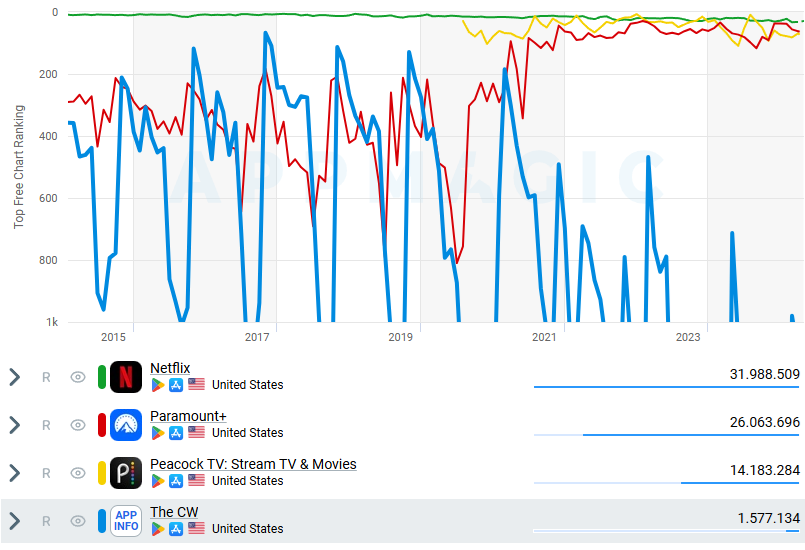
Popular entertainment video streaming apps and their U.S. download ranking over time. (source: AppMagic) While Paramount+ joined the leaders post COVID, The CW sunk into oblivion. New show releases cause the cyclical nature in the data.
Google Trends, as well, shows how the CW brand is dying:

National Websites
Nexstar present its portfolio of websites as a key asset in their digital ecosystem. (see also 1st page of Nexstar’s latest annual report 2023 PDF on their website) This is relevant because content distribution on their own websites allows for more control and better margins than reliance on third-party distributors like YouTube, Hulu, Instagram or others.
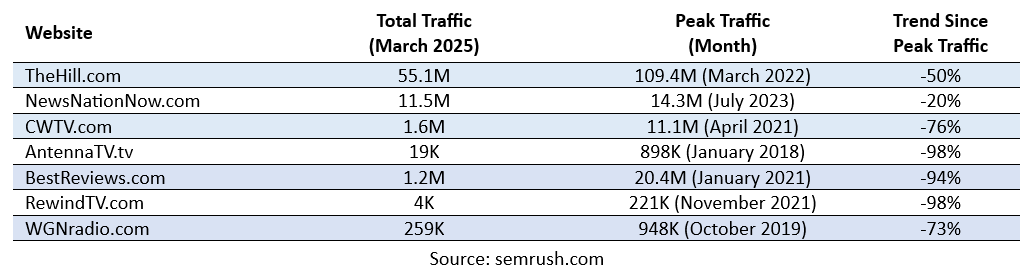
We observe a matching decline in interest in these brands in Google Trends data. Thus, a completely independent set of data validates our results.
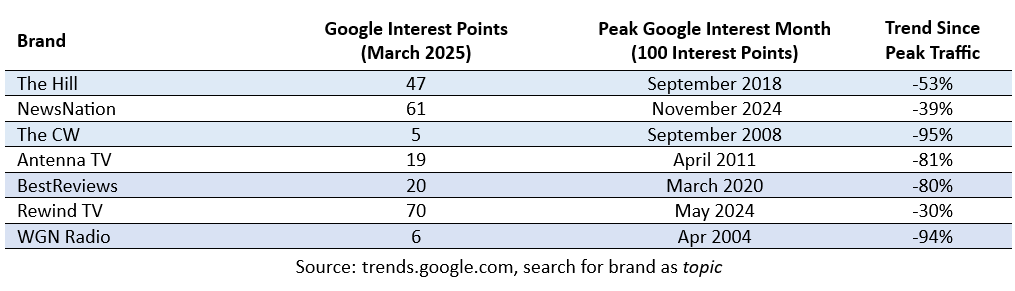
The low website traffic indicates a lack of interest and growth in the brands generally.
Traffic to CWTV.com and BestReviews.com crashed completely post COVID:
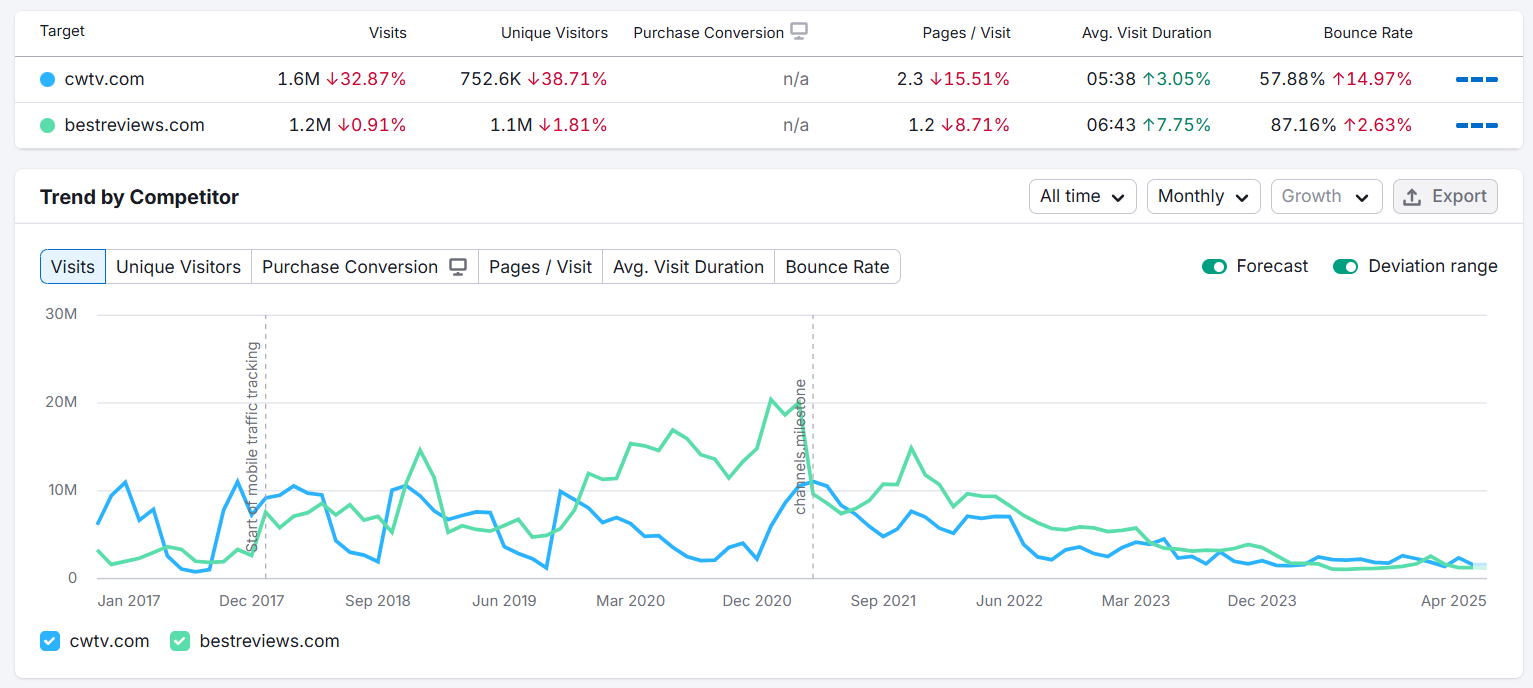
Global web traffic to domains from desktop or mobile (Source: Semrush)
Traffic to TheHill.com and NewsNationNow.com is declining in the last two to three years:
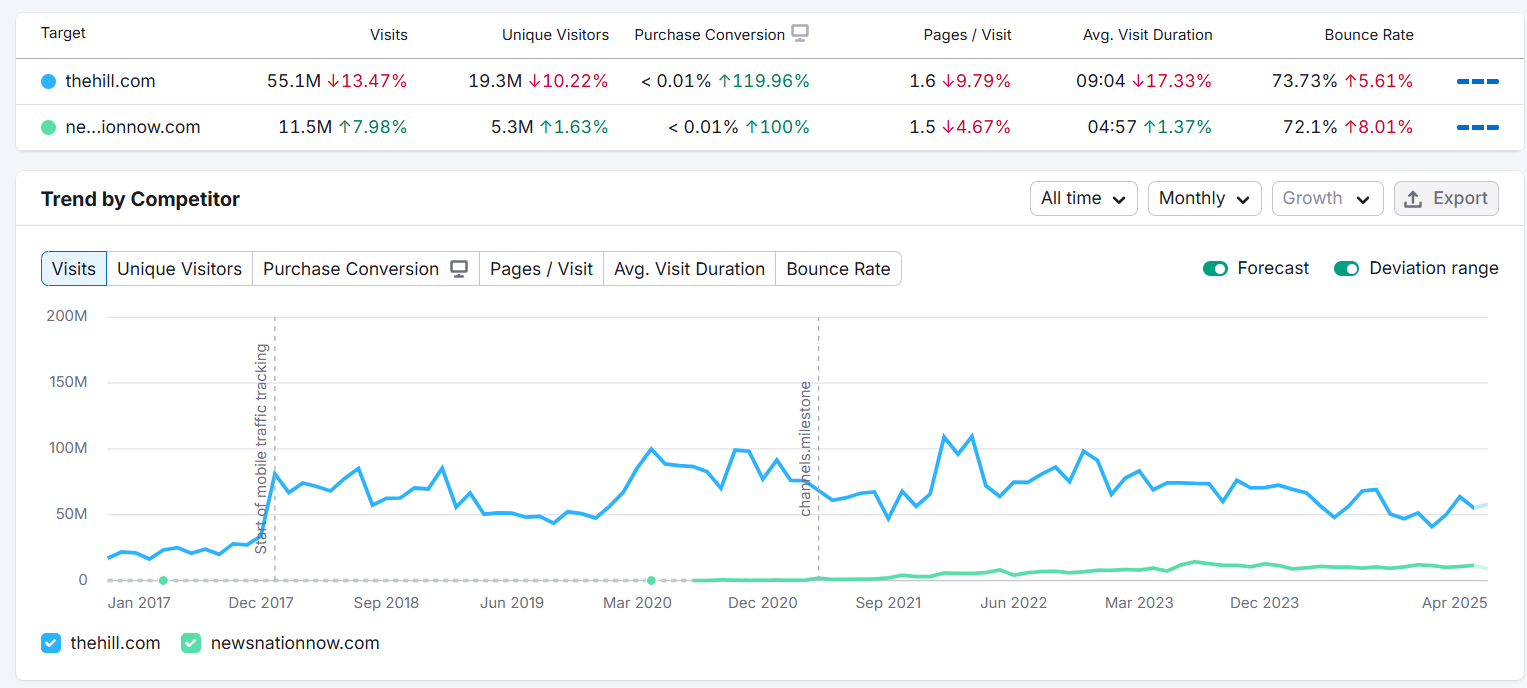
Global web traffic to domains from desktop or mobile (Source: Semrush)
Local Station Websites and Apps
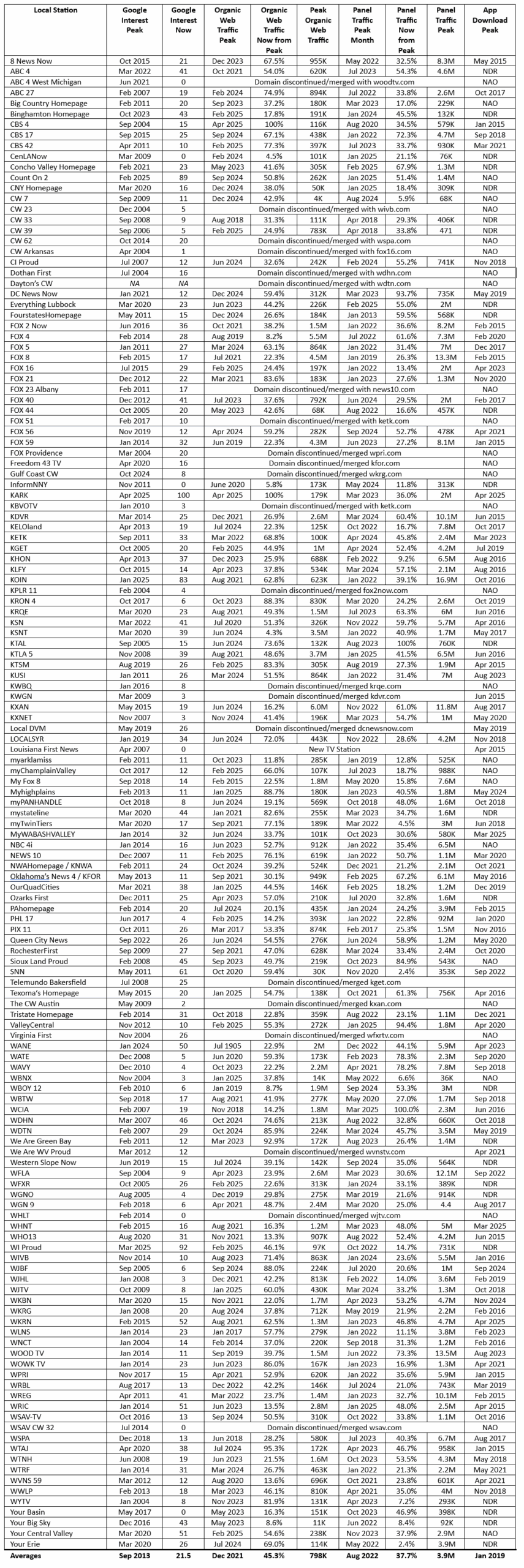
Like Nexstar’s national digital offers, the success of Nexstar’s local digital offers trends strongly downwards as well. On their website Nexstar presents 140 unique local TV station brands with a dedicated domain with:
- 22 domains being shut down or merged into other local website domains;
- Interest over Google searches peaked more than eleven years ago in September 2013, and is today down to only 21.5% of average interest;
- Website traffic from search engines on average peaked in December 2021 but is already down to 45.3%;
- Overall web traffic peaked on average in August 2022 and is down to 37.7%;
- 28 local stations do not have a mobile app, but from the 112 stations with apps, AppMagic shows 23 without any registered downloads of at least 5,000 in total;
- From the 89 local apps with registered downloads, the download numbers peaked in January 2019 on average.
The websites are almost all based on the same boilerplate blog design that looks outdated.
Find the detailed table for this analysis in the Appendix.
Local News Companies are Losing Their Moat
Some investors see a moat in local news TV broadcasting with the stations’ websites and apps. This is wrong because younger adults already consume more and more national and local news from social media. There seems to be a winner-takes-it-all situation with few social media players dominating the market while smaller players fall behind. Pew Research published a survey in June 2024 indicating that the majority of social media users consume news content through few social media platforms, most notably Twitter/X.
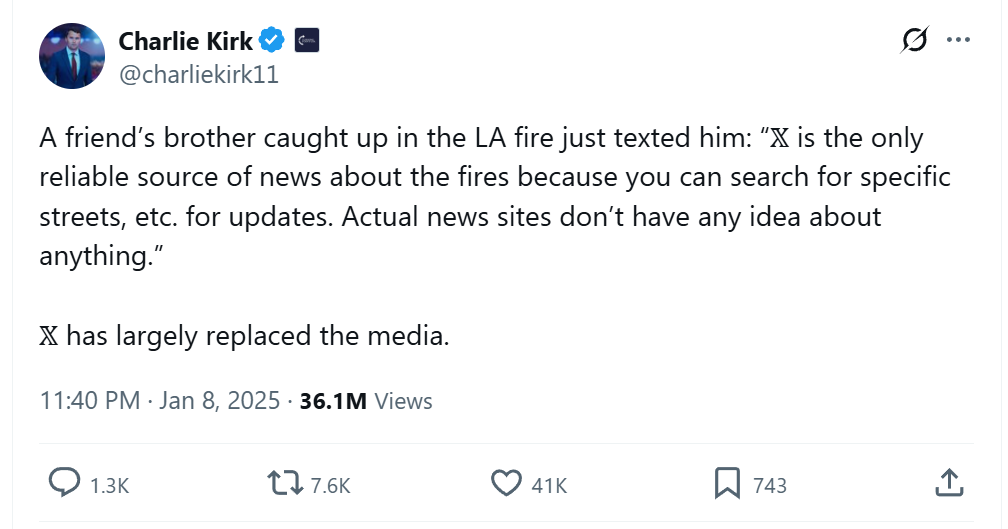
Source: x.com
Media companies need to get traffic to their own platforms to secure margins in ad sales, but the obvious trend in social media is towards a few big winners that dominate the ecosystem as opposed to a fragmented market where local websites have a chance to compete.
Third-Party Distribution
Nexstar’s YouTube channels, which feature news clips from its major outlets, have poor views and generate minimal ad revenue despite uploading thousands of videos.
Industry experts told us that other major media corporations have successfully negotiated agreements that secure a higher share of advertising revenue from their content on YouTube. Nexstar, however, does not have such an agreement with YouTube.
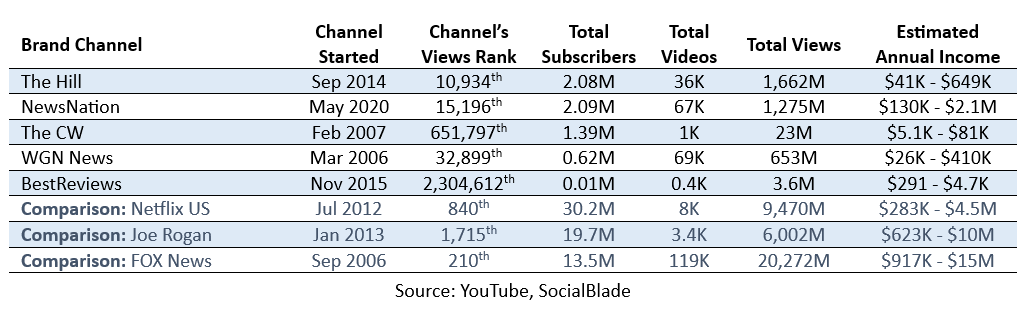
The following table shows Nexstar’s biggest brand channels on YouTube. In summary, an upload on YouTube has on average only 20.8K views and makes only $9.94 per year for Nexstar, which is no lucrative business model.
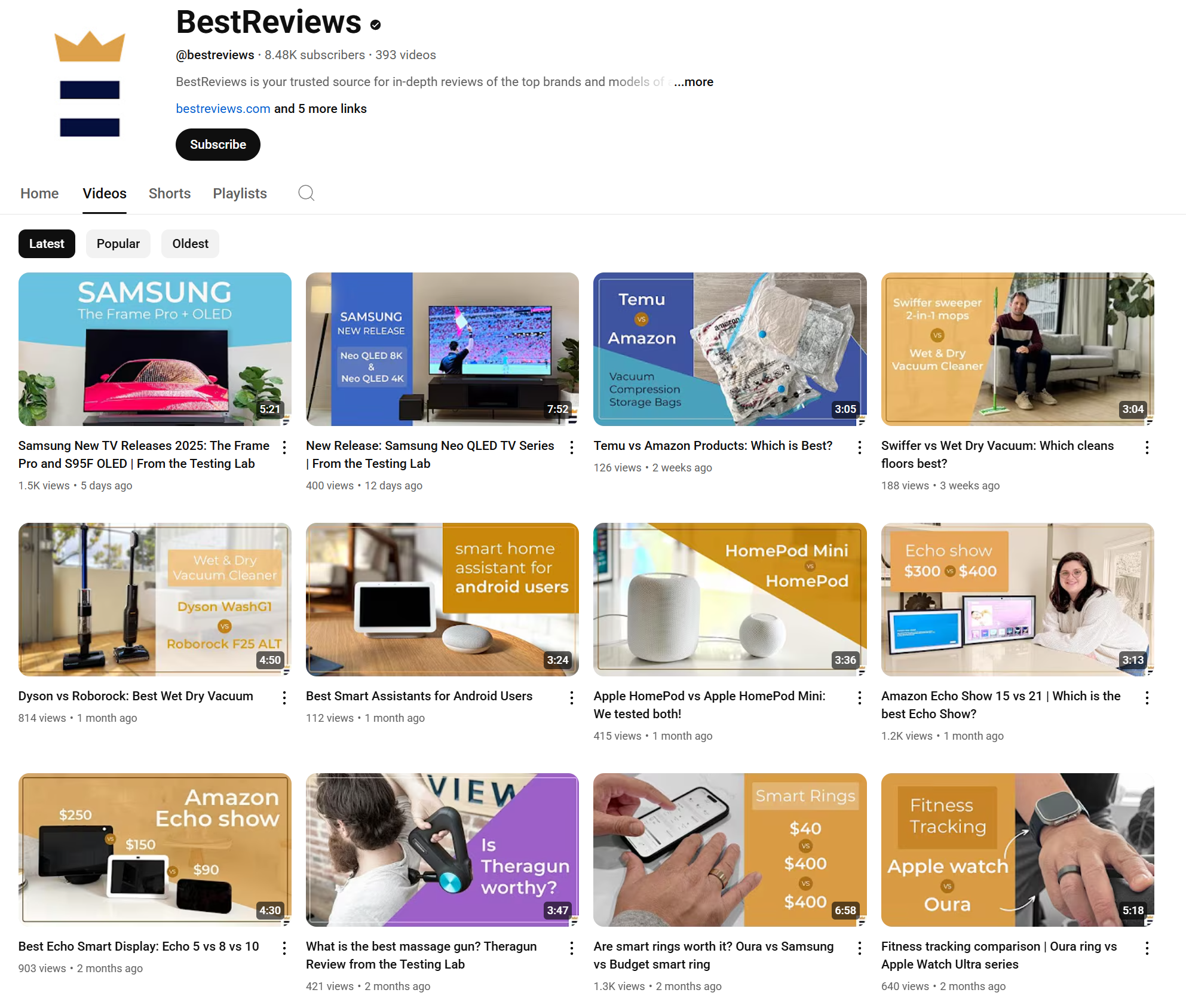
BestReviews’ videos only attract a few hundred viewers each (youtube.com/@bestreviews)
While social media platforms other than YouTube do not provide any meaningful monetarization opportunity, media providers can increase their branding and reach via a presence. Despite daily content uploads, Nexstar’s national key brands only have very weak followings on the major social media platforms.
Nexstar claims to have seen “nearly 103 million monthly unique users on average” on their websites and reaches “126 million television households”. Their social media following doesn’t reflect this reach.
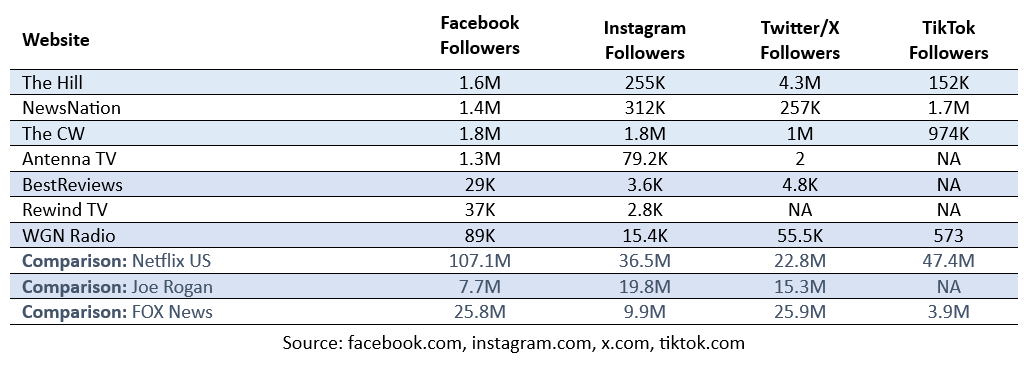
The Hill is Nexstar’s best performer on Twitter/X. When Nexstar acquired The Hill in August 2021, their Twitter/X presence already had 4.24 million followers, i.e. the count is stagnating on the platform.
The CW is the only brand with meaningful Instagram followership. However, their followership is declining by over a thousand followers per week in the last twelve months on average. (source: SocialBlade)
The Twitter/X handle @AntennaTV is even mentioned on Nexstar’s website despite having no content and only two followers. Apparently, no one at Nexstar reviews such information on their website.
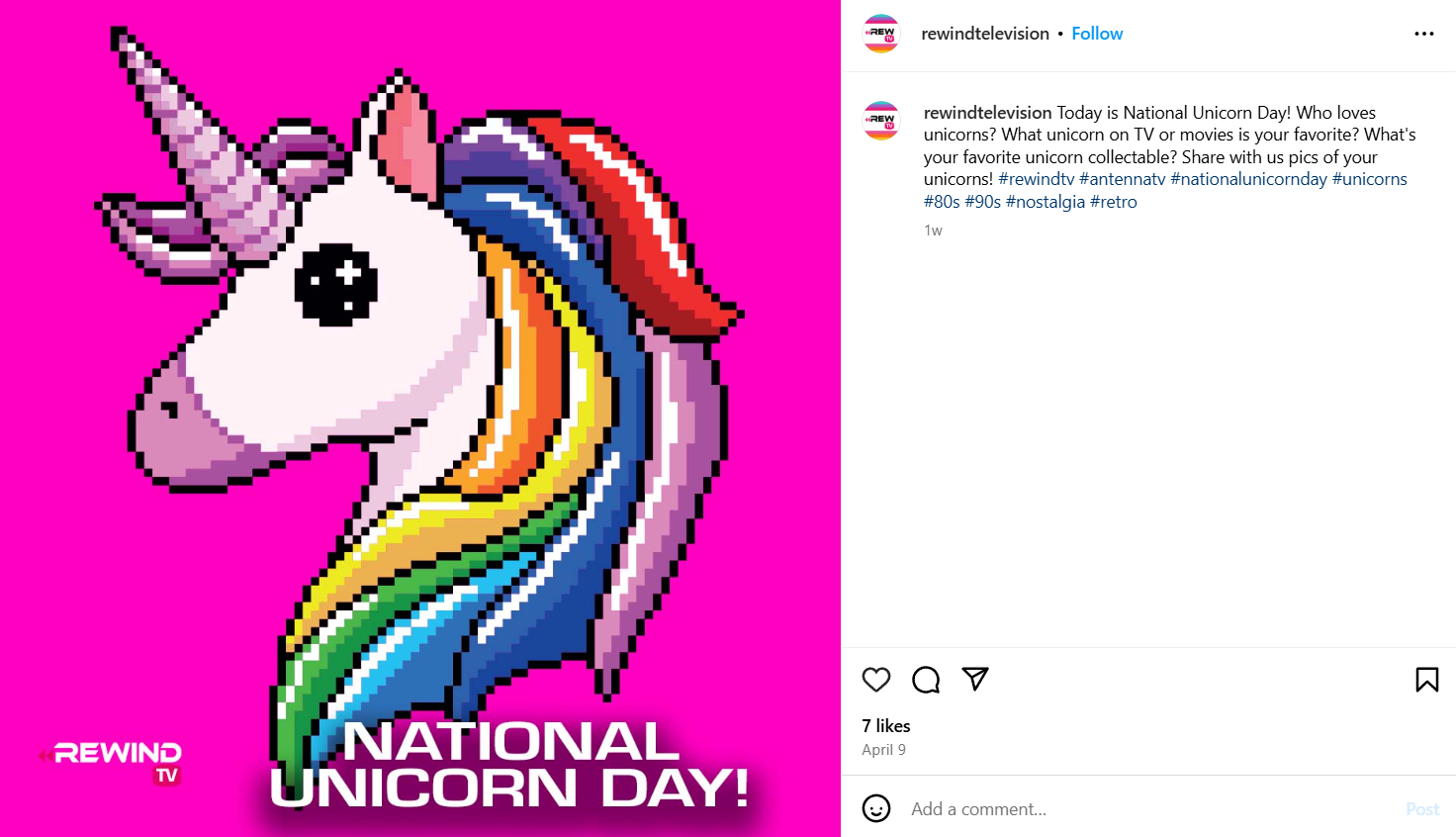
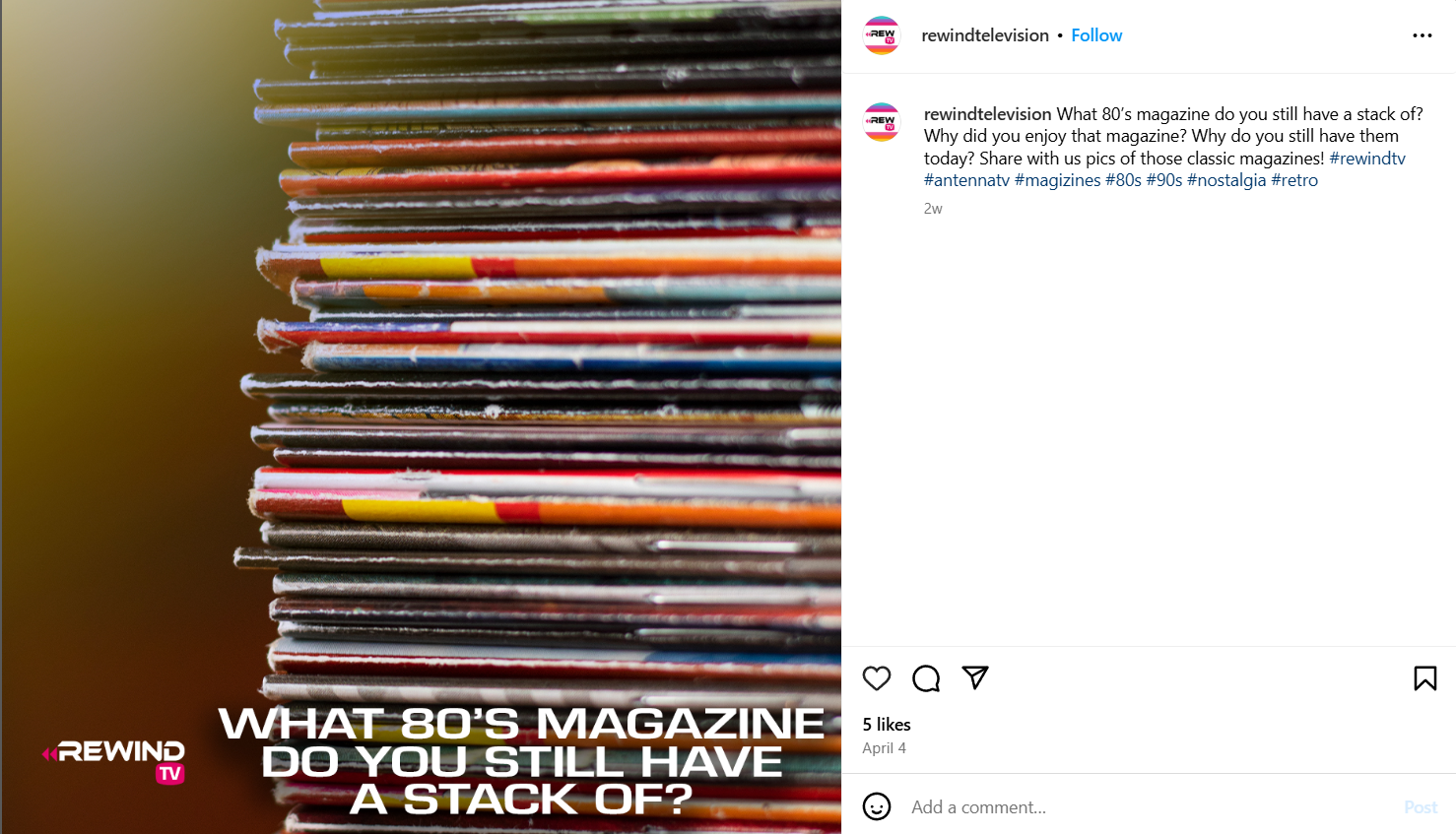
RewindTV’s daily content uploads attract barely any engagement. Most have less than 30 likes over lifetime. (instagram.com/rewindtelevision/)
We see a consistent pattern across Nexstar’s digital portfolio. After the acquisition by Nexstar the assets seem to be consistently declining and drifting towards irrelevance.
Nexstar’s Goodwill Exceeds Shareholder Equity
Nexstar’s balance sheet shows a high proportion of goodwill from past acquisitions that include linear and digital assets. At the end of 2024, Nexstar records $2,922M in goodwill at total shareholders’ equity of $2,242M, which indicates that the company’s valuation heavily depends on future earnings potential from their acquisitions. Much of this goodwill is reflected in synergy and network effects that these acquisitions should have brought.
Nexstar has only impaired a small portion of its goodwill relating to its underperforming digital assets. During the third quarter of 2019, Nexstar recorded a non-cash impairment charge of $63.3 million related to goodwill and intangible assets of its digital business. In the fourth quarter of 2022, Nexstar recorded a $96.1 million goodwill and intangible assets impairment on their “product review and recommendation platform reporting unit,” which likely is the business around BestReview.com. During the fourth quarter of 2023 Nexstar recorded a goodwill impairment of $19 million “second digital reporting unit that has no remaining goodwill and no material long-lived intangible assets balance.” (K-10 2023, p. 47) In 2024, Nexstar reported $24 million of goodwill impairment of “a digital business.” (K-10 2024, p. 36)
The remaining goodwill on Nexstar’s balance sheet implies promises of future cash flows that can only materialize if there is a future business left. Most of the industry experts we talked to believe that the future prospects of linear TV are very dim, and, as we showed, Nexstar has no future in digital offerings. One high-ranking former Nexstar employee said the company has “a year and a half” left with their current business model.
Insider Selling
After the COVID-related market turbulence in 2020, no insiders dared to buy Nexstar shares but sold a significant number of shares. Over the last six months, insiders sold shares worth $48.1 million. Several officers and directors sold shares. We see this as an indicator of mistrust in the company’s future strategy.

Source: SECform4.com
Conclusion
In conclusion, we believe that Nexstar is operating in a dying business, and its digital strategy is failing. We find the picture that the company paints about its digital segment and overall business health misleading. We were surprised to encounter such a consistently negative sentiment in our sixteen insider interviews with the resounding message being that Nexstar is doomed for failure. Nexstar might have some puffs from the legacy TV cigarette bud left, but the company seems completely unable to successfully move their strategy to the highly competitive and growing digital market. We believe investors that are buying into the stock now are walking into a value trap.
Appendix
Local TV Station Statistics